Updated: December 17, 2025

The world is changing, and the way we work is changing with it.
In 2026 and the years after that, we can expect work trends such as AI and automation to thrive along with hybrid work, upskilling, polyworking, and more.
Both employers and employees are shaping the way work will look — seemingly just as much as artificial intelligence or the state of the economy do.
Let’s dive right into the future of work trends for 2026.
- 74% of employers are struggling to find the talent they need.
- 71% of surveyees claim job security is becoming a thing of the past.
- 92% of companies plan to increase their AI investments over the next 3 years.
- Employees can future-proof their career through upskilling, brand building, even freelancing.
Trend #1: Voluntary employee turnover is declining
Employees want workplace flexibility. When they don’t have it, they tend to leave for a place offering what they need — although not as much as they used to.
According to CIPD’s Flexible and hybrid working practices in 2025 report, 3% of employees quit jobs that didn’t offer flexibility. While this may not sound like much, it translates to 1.1 million employees.
The average voluntary turnover rate for 2025 in the US is 13%, which is a decline from 2023, when the voluntary turnover rate was 17.3%, as noted in the 2025 US Mercer Turnover Survey.
The most notable turnover rate was seen in the Retail and Wholesale Industry, with 26.7% of employees leaving. Meanwhile, the Insurance/Reinsurance industry saw only 8.2% of employees quit.
Regardless of the industry, it’s vital that employers feel the pulse of their employees’ satisfaction and take actionable steps to reduce the turnover even more.
Trend #2: Talent mobility will likely increase
Many companies have changed their policies regarding hiring and preferred work models.
Remote work has opened more opportunities for people to work for companies that didn’t consider hiring employees from outside of their cities or countries before.
However, remote work is only one of the factors influencing the increasing mobility of talent. Global talent shortage also plays a huge role.
The EY Mobility Reimagined Survey found that mobility is one of the greatest assets to overcoming a global talent shortage.
The ManpowerGroup’s Global Talent Shortage Report for 2025 reveals that 74% of employers are struggling to find the talent they need.
Their survey of over 40,000 employers across 40 countries and territories showed that talent shortage is high across all industries.
| Talent shortage % | Industry |
|---|---|
| 77% | Healthcare & Life Sciences |
| 76% | IT & technology |
| 76% | Energy & Utilities |
| 74% | Transport, Logistics & Automotive |
| 73% | Consumer Goods & Services |
| 72% | Financials & Real Estate |
| 71% | Communications |
Source: ManpowerGroup, Global Talent Shortage Report for 2025
Companies want to attract and retain top talent. And due to a global talent shortage, offering flexible work models is an efficient way to bring in new experts.
Trend #3: Employees expect the employer to care about their well-being
The year 2026 will see an even higher rise in employees valuing their well-being.
Gone are the days when people would just go to work and stress out. Now, employees want more from their employers.
85% of employees find the employer responsible for helping them achieve well-being, according to Wellhub’s 2025 The State of Work-Life Wellness report.
And a whopping 88% of employees find well-being at work equally important as their salary.
Statistics show that 8 out of 10 employees would consider leaving the company that doesn’t focus on employee well-being.
This is a major callout to employers to pay close attention to employees’ welfare as it directly affects all segments of business.
For example, employees’ well-being implies a greater work-life balance. And work-life balance reduces turnover, solves productivity challenges, and decreases the levels of absenteeism and even lateness.
Additionally, a Gallup survey found that $322 billion is lost globally every year due to employee burnout, through increased turnover and lost productivity.
In short — employees now prioritize their well-being over work, which will likely continue in the future.
Further reading:
Dive deeper into employee well-being statistics and find out more about 2025 workplace stats as well:
Scale your business with CAKE.com tools
Increase productivity and grow your organization with Clockify, Pumble, and Plaky.
Trend #4: Employees want better job security
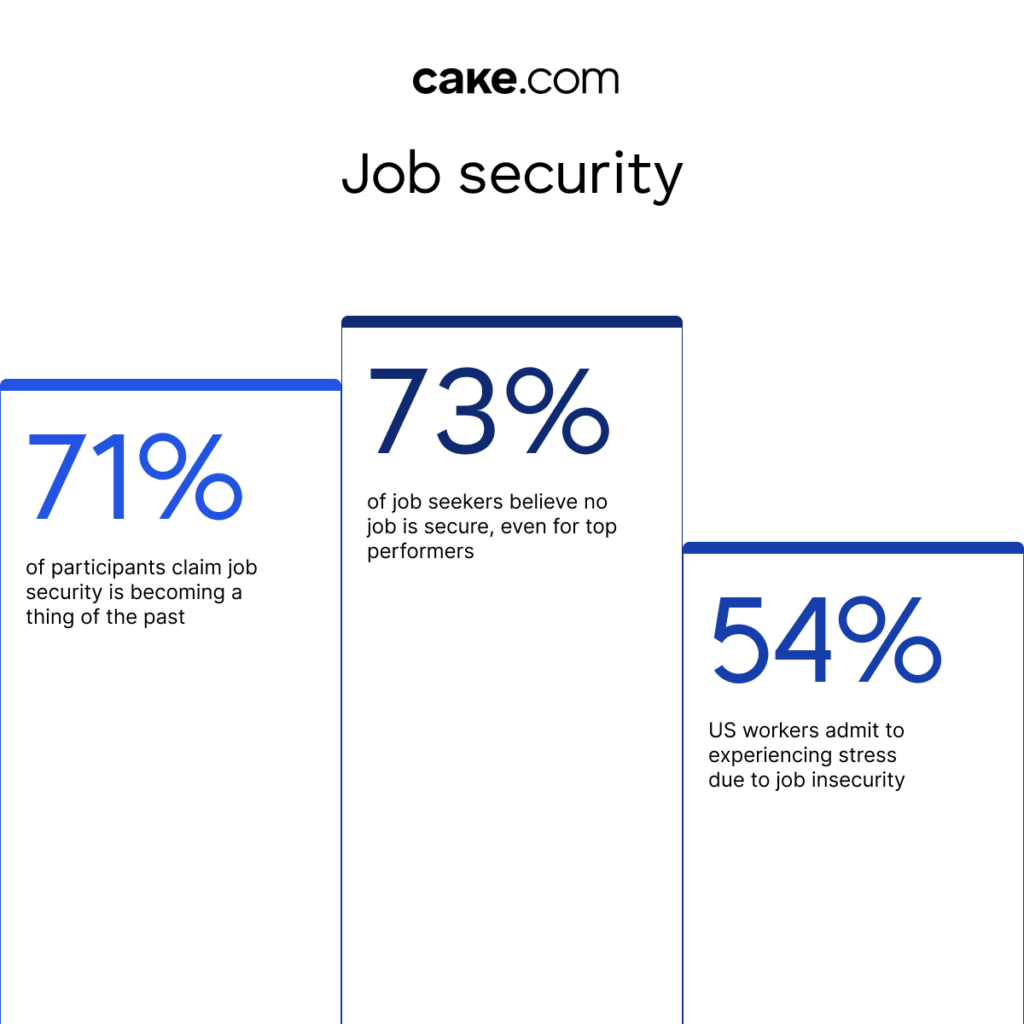
The latest Express Employment Professionals-Harris Poll survey reveals that 73% of job seekers believe no job is secure, even for top performers.
The survey also shows that job insecurity isn’t a temporary thing, with 71% of participants claiming that job security is becoming a thing of the past.
State-wide job insecurity inevitably leads to stress.
For example, the American Psychological Association’s 2025 Work in America™ survey found that 54% of US workers admit to experiencing stress due to job insecurity.
This isn’t a surprise as the Survey of Professional Forecasters predicts that the unemployment rate in the US will grow to 4.5% in 2026, a rise from 4.2% in 2025.
Big companies have also made tough decisions about laying off personnel. Microsoft, for instance, plans to cut 9,000 of its employees, according to CNBC.
Regardless of the gloomy stats and the popular belief that job security is gone, workers are still trying to secure their jobs through upskilling, for example (see Trend #8 below).
Essentially, employees seek stability, and employers must show up as a stabilizing force they can count on in uncertain and turbulent times.
Trend #5: Polyworking is on the rise
The Monster’s Polyworking survey from 2025 reveals that almost half of the US survey respondents (47%) engage in polyworking — having 2 or more jobs, projects, or gigs.
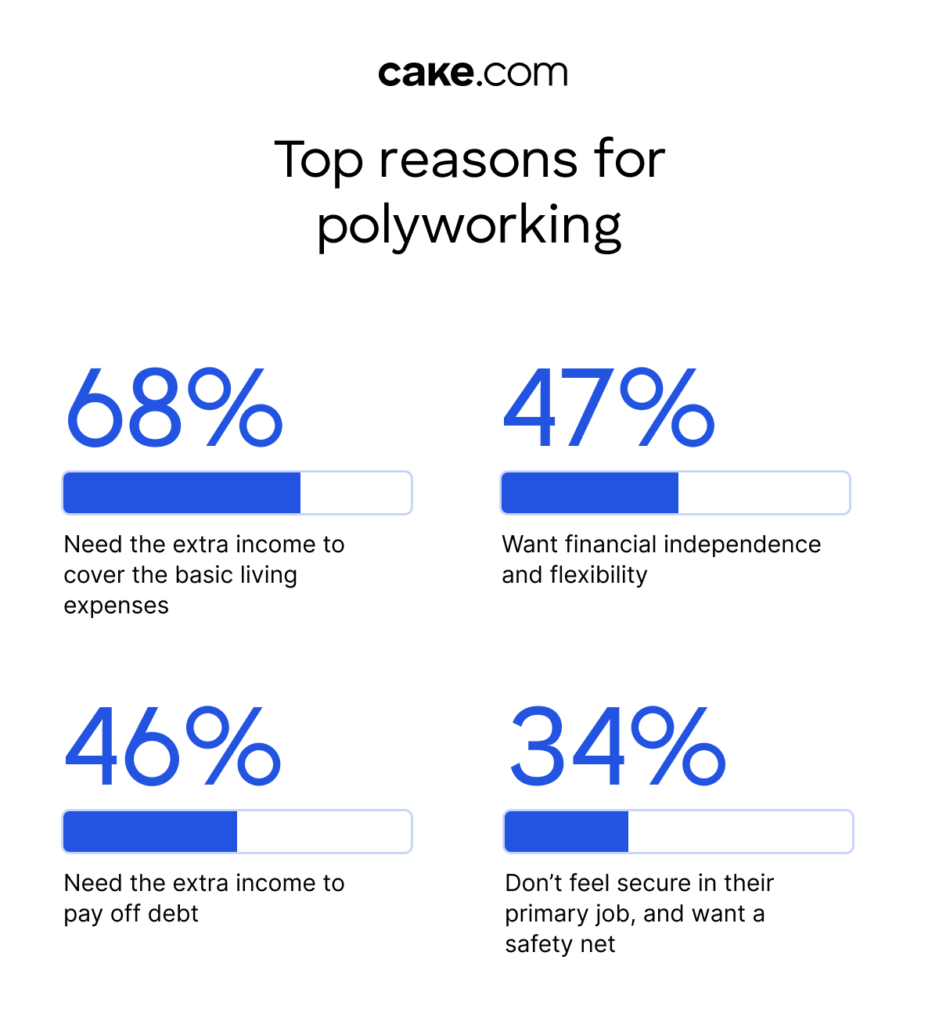
There are many, often intertwined, reasons for this:
- Need the extra income to cover basic living expenses — 68%,
- Want financial independence and flexibility — 47%,
- Need the extra income to pay off debt — 46%,
- Don’t feel secure in their primary job, and want a safety net — 34%.
Obviously, the main reason for getting a second job isn’t greed but pure necessity.
As per Owl Labs’ 2025 State of Hybrid Work report, Gen Zers are more likely to get a side job (38%), compared to Millennials (31%), Gen Xers (20%), and Boomers (13%). As Gen Zers are the youngest generation in the workforce, we can expect the polyworking trend to continue in the years to come.
Further reading:
Find out more about the impact Gen Zers have on workforce transformation:
Trend #6: Remote and hybrid work continue to flourish
If you’re thinking about introducing a back-to-office mandate — think twice. There’s a good chance that you will lose your talent.
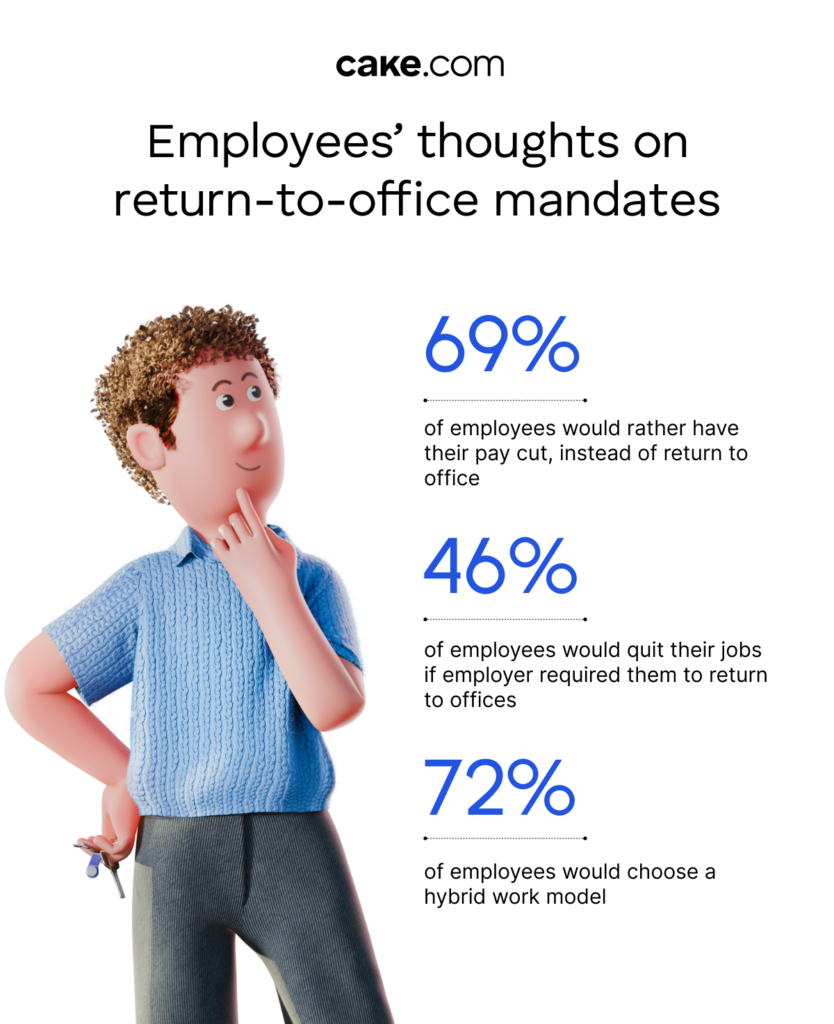
According to FlexJobs’ 2025 State of the Workforce Report, 69% would rather have their pay cut than return to the office.
Similarly, the Pew Research Center survey shows that 46% of employees would quit their jobs if their employer required them to return to offices.
The hybrid work model remains the best option. 72% of employees who don’t work from the office would choose a hybrid work environment, and only 24% would choose to work from home all the time.
At the same time, research such as CIPD’s Flexible and Hybrid Working Practices in 2025 found that 53% of companies offer incentives to motivate employees to work from the office more often. These include flexible working hours and in-person professional development programs.
However, work-from-office is no longer the norm, so companies must rethink their ways of working — for their own good.
Further reading:
If you are considering return-to-office mandates, make sure to learn all about them beforehand:
Trend #7: Employers are investing in employee well-being programs
Employee well-being has become the new workplace imperative.
The latest Gallup State of the Global Workplace 2025report states that only 33% percent of surveyed employees are thriving in their overall well-being.
A low well-being score means a higher number of absence leaves. The CIPD’s Health and Wellbeing 2025 report shows that the average absence per employee is 9.4 days, which is the highest number seen in 17 years.
Mental health issues are one of the top reasons for both long-term and short-term absence, according to the same report.
For example, in Wellhub’s 2025 The State of Work-Life Wellness report, 47% of employees admit that stress at work is affecting their mental health.
That’s why 57% of companies now have a well-being strategy in place, compared to 44% of companies in 2023, according to the CIPD report we mentioned.
We can expect this number to continue to grow in the future, as employees need both mental and physical well-being programs to be able to thrive at work.
And not only that, but employees are determined to feel well again. As per the same Wellhub report, a staggering 83% of surveyees would consider leaving the company if it doesn’t focus on employee experience and well-being.
Trend #8: Future-proofing careers is a natural consequence of the constant labor market changes
With the surge of AI and automation, a weakened US labor market, and an increasing number of technical companies laying off employees (like Microsoft, for example), future-proofing careers is a useful trend to hop onto.
There are plenty of ways to future-proof your career, according to Forbes:
- Upskill — Gain knowledge and experience in skills like AI, data analysis, and project management.
- Switch to a different career — Pivot to a career that is more trendy, such as cybersecurity, for example.
- Build your own brand — A strong digital presence will ensure your career is safe in the years to come.
- Freelance — Freelancing, such as Upwork, allows you to be more autonomous in the type and quantity of work that you do.
According to the World Economic Forum’s Future of Jobs Report 2025, around 170 million new jobs in total will have appeared by the end of this decade.
But, while new jobs will continue to pop up, it’s vital that we gain the necessary skills to perform them.
Trend #9: AI isn’t going away, but it’ll become more of an assistant than a direct human replacement
Forbes recognizes AI and automation as one of the top global trends that will shape the workplace culture in 2026.
Over the next 3 years, 92 percent of companies plan to increase their AI investments, according toMcKinsey’s Superagency in the Workplace: Empowering People to Unlock AI’s Full Potential.
While fear of being replaced by AI is real, the Budget Lab at Yale 2025 research shows that the labor market hasn’t suffered any major changes since ChatGPT was released 3 years ago.
However, an interesting future trend to keep an eye on is that the majority of employees will rely on AI to help them do their tasks. According to Microsoft’s 2025 Work Trend Index Annual Report, a whopping 75% of knowledge workers are already using AI in some capacity.
Scale your business with CAKE.com tools
Increase productivity and grow your organization with Clockify, Pumble, and Plaky.
Trend #10: Skill-based hiring continues to dominate
Skill-based hiring focuses on a candidate’s practical skills and performance instead of formal qualifications.
As Ryan Roslansky, CEO at LinkedIn, said, “skills are the new currency.” According to him, a skills-first labor market is emerging all around us.
And he’s not the only one thinking that.
The World Economic Forum also recognizes the shift to skill-based hiring as one of the key global trends shaping the new world of work. According to its Future of Jobs report 2025, 39% of employees’ skill sets will be transformed by 2030.
This makes skills-based hiring crucial for finding new employees — and for helping them overcome skill gaps too. Having the right skills makes both employers and employees ready for the jobs of the future, according to the World Economic Forum.
So, it comes as no surprise that 81% of C-suite executives plan to adopt skills-based hiring practices in the future, as found by Upwork Research Institute.
Companies must adapt to upcoming work trends to grow
While we cannot know for sure what the future holds, we do know that having the right set of skills is paramount for thriving in any industry.
Companies need to implement programs that will support employees’ growth in terms of gaining new skills that are/will be in demand — without ever looking back.
At the same time, employee well-being is another core part of a successful business. Employees prioritize their well-being more than ever before, and companies must invest in well-being programs to attract and retain talent.
In the end, keeping up with the future is never easy, but it’s the only way to future-proof your company.
One thing is certain — high-quality work is always in trend. Become more efficient with the CAKE.com Bundle. Try it out today.
How we reviewed this post: Our writers & editors monitor the posts and update them when new information becomes available, to keep them fresh and relevant.