Updated: August 24, 2026

Gen Zers — people born between 1997 and 2012 — have a bit of a bad reputation in the workplace: “no work ethic, unemployable, lacking social skills, etc.” But is this justified? Is Gen Z really the least hireable generation, or are we on the brink of redefining the modern workplace?
Gen Z has been part of the workforce for the better part of the decade now. So, let’s see what cold, hard stats have to say about this so that we can truly understand what Gen Zers are like.
To do this, we’ve compiled the latest Gen Z workplace statistics from reputable sources and repeated our CAKE.com Gen Z in the Workforce study from August 2024 with new data from July 2026. This July 2026 study included 62 participants from 2 focus groups (managers and Gen Z employees), with each group given a survey tailored to their role.
Managers were asked about their experiences and challenges in managing Gen Z employees, while Gen Z employees were asked about their work preferences and expectations.
Together, these statistics will give you a clear picture of what Gen Zers bring to the workforce, what they want from it, how they’re seen, and more.
- By 2030, Gen Zers will make up 30% of all employees
- 47% of Gen Zers are career-oriented
- 49% of Gen Zers use AI to improve their skills
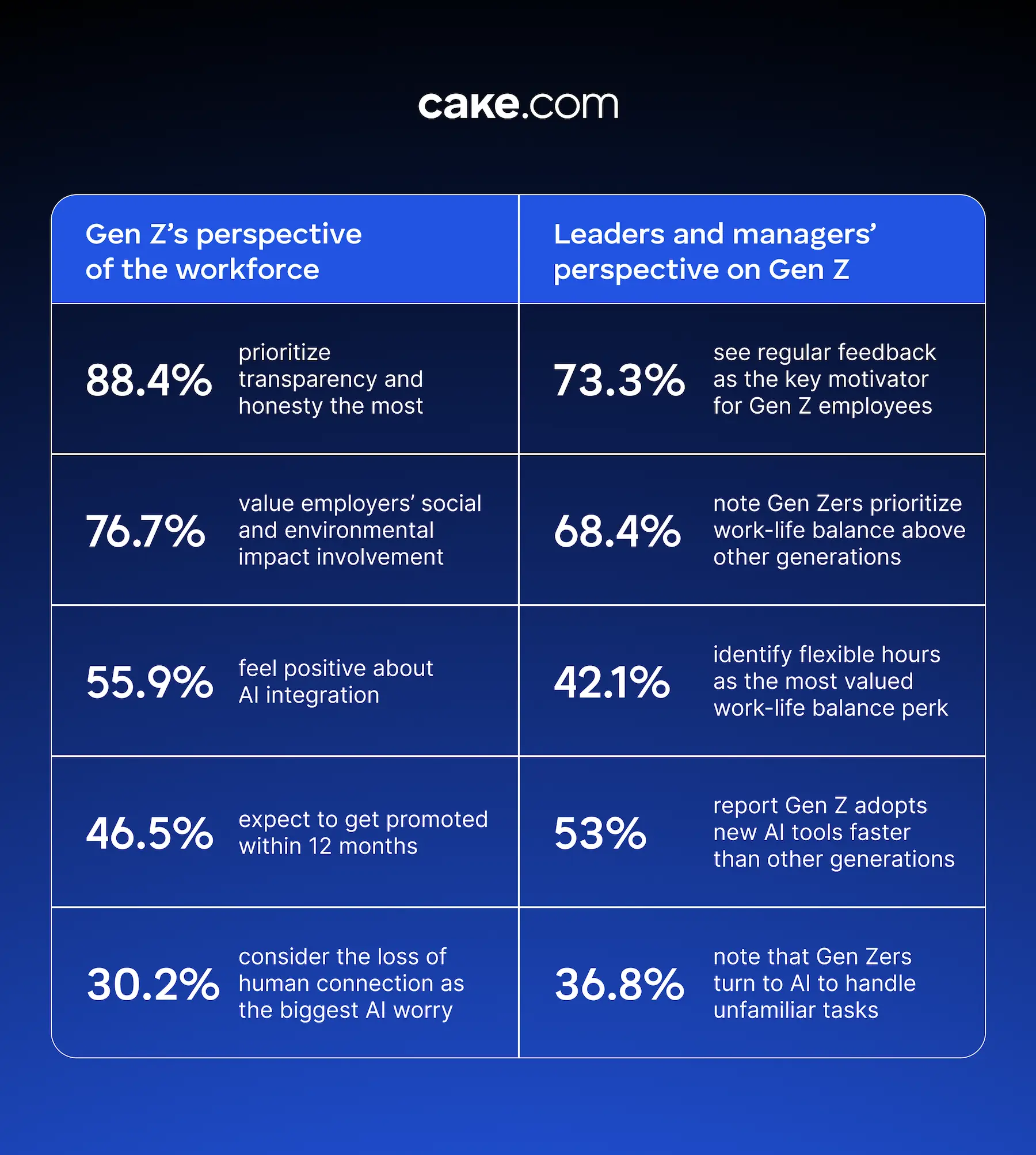
- 55.9% of Gen Zers feel positively about AI integration
- 55% of Gen Zers use AI to solve problems
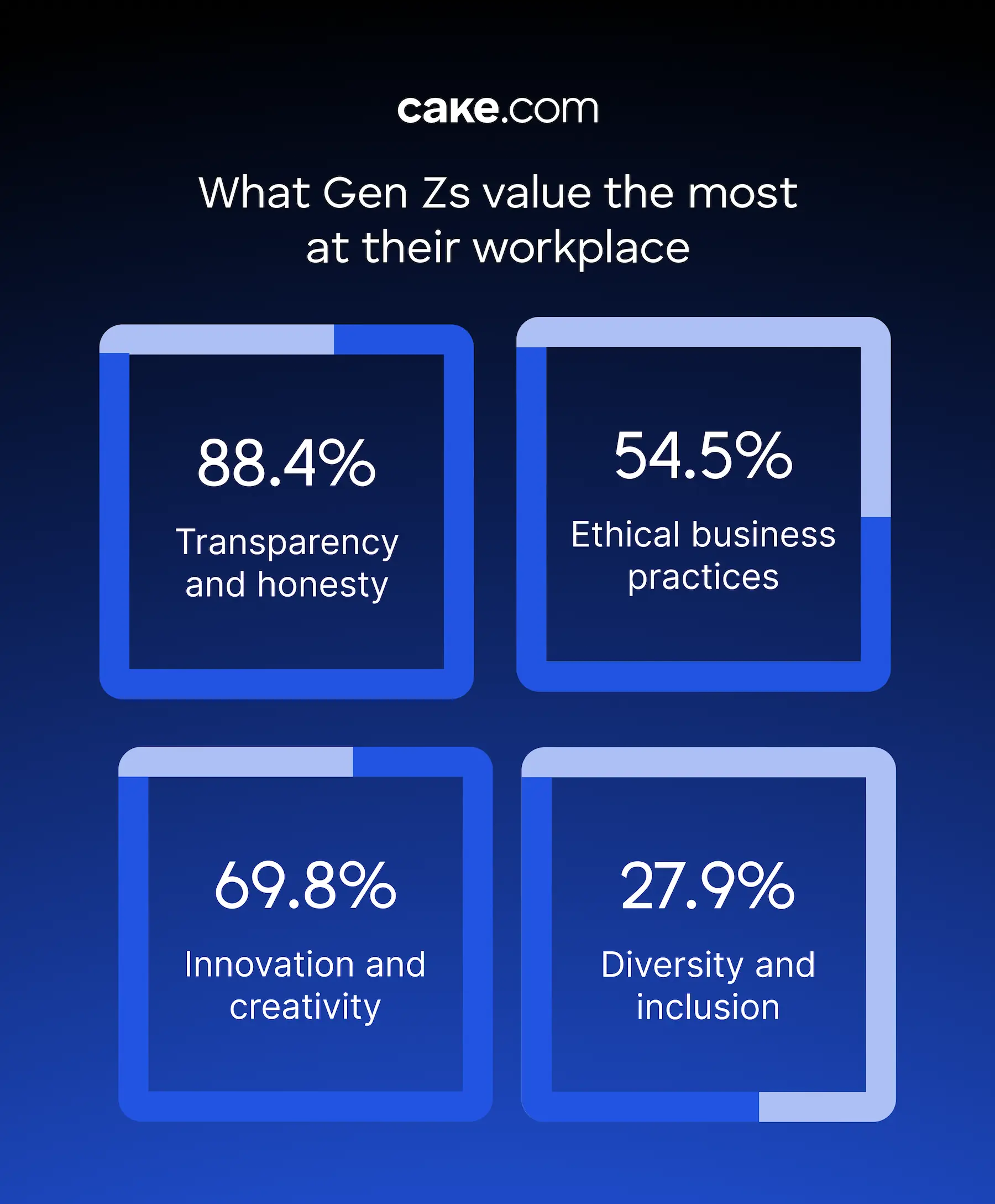
- 88.4% of Gen Zers prioritize transparency and honesty at work above other values
- 71% of Gen Zers want to work in a hybrid workplace
- 42.1% of managers say Gen Zers prefer flexible working hours over other benefits
- 1 in 10 hiring managers claim they’ve had Gen Z candidates bring a parent to an interview
- 45% of hiring managers — including Gen Z hiring managers — plan on hiring more Millennials because they find Gen Zers challenging to work with
How many Gen Zers are there in the workforce?
In 2024, when the most recent US government report on labor force demographics was released, Gen Zers made up 18% of the labor force. And the trend is increasing steadily, with the second quarter of 2024 marking the first time in history that there were more Gen Z employees (18%) than Baby Boomers (15%) in the workforce.
According to McKinsey’s Quarterly report, Gen Zers are estimated to make up 30% of all employees by 2030. Freeman estimates that, by 2030, Millennials and Gen Z will make up 75% of the total workforce.
What does Gen Z bring into the workforce?
As a large share of the working population, Gen Zers already have a voice in the modern workplace.
Let’s look at exactly what they bring to the office.
47% of Gen Zers are career-oriented
Gen Z gets a bad rep for spending more time on their phones than any other generation, but this hasn’t made them any less ambitious.
A GWI report shows that, despite 25% of the Gen Z workforce spending at least 6 hours a day scrolling, 47% still consider themselves career-focused. In fact, 20% of them are so focused on climbing the corporate ladder that they feel overworked.
Further reading
Overworking can take a toll on the quality of life beyond what you’d expect. Read more on how to avoid getting overworked:
49% of Gen Zers already use AI to improve their skills
The previously mentioned GWI report shows that 49% of Gen Z employees use AI to improve their skills on a regular basis.
In fact, according to McKinsey’s The State of Organizations 2026 report, Gen Zers are more likely to view AI agents not just as tools, but as active collaborators.
And even within Gen Z, there’s a significant increase in AI adoption by generation. According to JoinHandshake’s The Class of 2026 in the AI Economy report, 85% of the Class of 2026 seniors report using generative AI tools during college. This is roughly a 50% increase compared to the Class of 2024 just 2 years prior. Additionally, 24% of Class of 2026 students use AI daily, nearly double the 13% reported by the Class of 2024.
Gen Zers are becoming less negative about the integration of AI in their workplace
In 2024, when we first conducted our CAKE.com study and asked Gen Z employees how they would feel about AI integration in their workplace:
- 21.9% said they would feel negatively or very negatively
- 40.6% were neutral about it
- 37.5% said they would feel positively or very positively about it.
In 2026, when we repeated the study:
- 0% of the participants said they felt negatively about AI integration in their workplace
- 44.2% were neutral about it
- 55.9% felt positively or very positively about it.
This massive shift in attitude shows that Gen Z is becoming increasingly welcoming toward workplace AI integration.
Other sources corroborate this attitude shift, with the Deloitte 2025 Gen Z and Millennial Survey showing that 59% of Gen Zers believe Gen AI skills are somewhat or highly required for career advancement.
Scale your business with CAKE.com tools
Increase productivity and grow your organization with Clockify, Pumble, and Plaky.
55% of Gen Zers use AI to solve problems at work
More than half of Gen Z workers (55%) use AI to solve problems at work, according to Randstad’s Gen Z Workplace Blueprint.
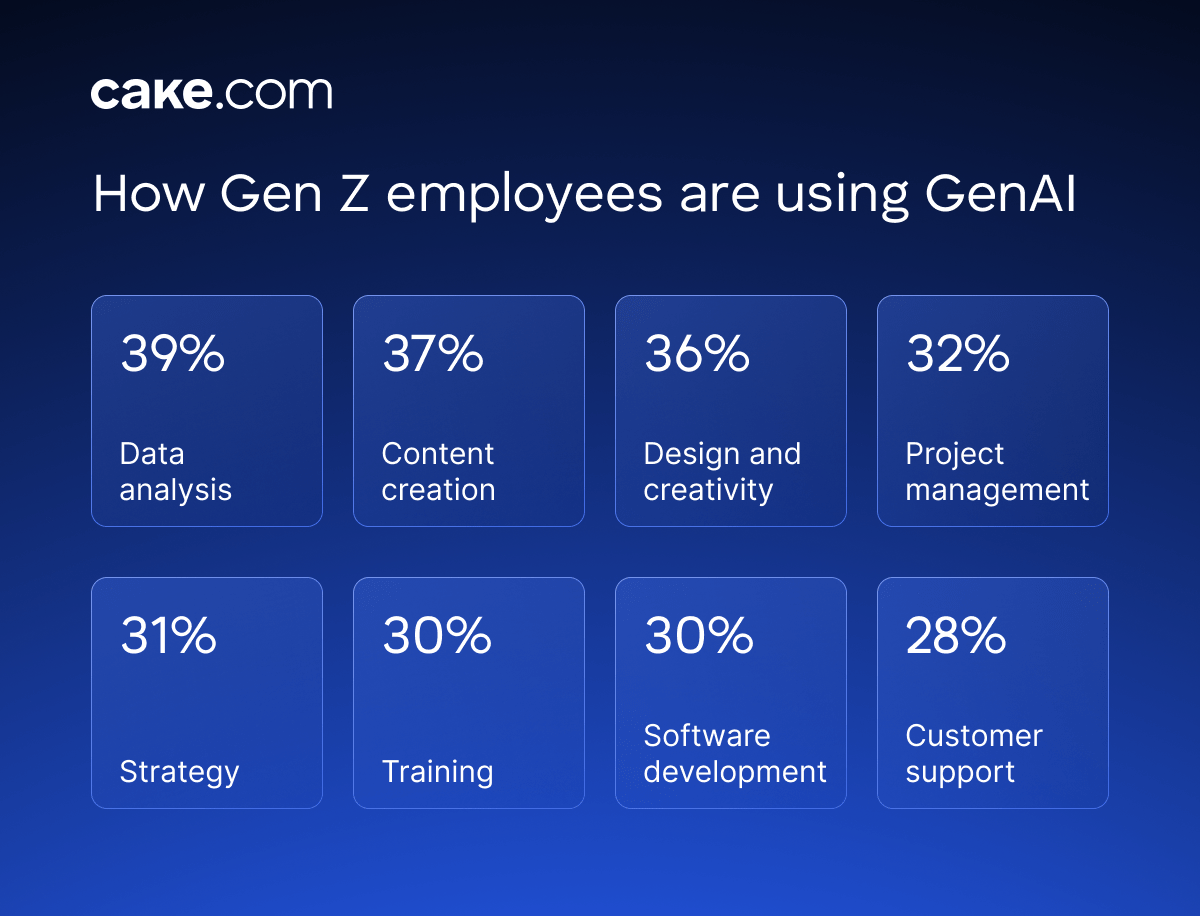
According to the Deloitte 2025 Gen Z and Millennial Survey, this is what Gen Z employees use AI for:
- Data analysis — 39%
- Content creation — 37%
- Design and creativity — 36%
- Project management — 32%
- Strategy — 31%
- Training — 30%
- Software development — 30%
- Customer support — 28%
Our CAKE.com study reveals that 36.8% of Gen Z employees turn to AI when faced with a task they don’t know how to perform. For reference, 52.6% ask their manager/mentor for help, while 10.5% take the trial-and-error approach until they find the solution that works.
21.9% of Gen Zers view learning and development as their top motivator
As part of our 2024 CAKE.com Gen Z study, we asked Gen Z employees what motivated them the most at work. Learning and development opportunities ranked 4th, with only 11.6% of respondents saying it was their top motivator.
We asked the same question during our 2026 CAKE.com Gen Z research, and were surprised to see a large shift in attitude: learning and development opportunities shared the top spot (21.9%) with competitive salaries as the top motivator for Gen Z employees.
As for how they approach learning and development, Deloitte’s 2025 Gen Z and Millennial Survey shows us that 31% of Gen Zers decide not to pursue higher education. Instead, 45% are open to taking on side projects or small gigs to expand their professional development, while 42% consider on-the-job training to be the best tactic, according to a 2024 Indeed global study.
In fact, according to the CAKE.com study, 51.2% of Gen Z employees expect their employer to allocate 1-2 hours a week for learning/upskilling, 34.9% expect 3-5 hours, and 9.3% expect more than 5 hours per week for this.
78.9% of Gen Zers prefer instant messaging platforms for internal communication
According to CAKE.com research, 78.9% of Gen Z employees list instant messaging as their preferred channel for internal communication. For reference, 15.8% listed video calls, 5.3% face-to-face communication, and exactly 0% listed emails.
Research from Barclays LifeSkills found that Gen Zers prefer instant messaging platforms to email at work because they let you show your personality through GIFs, emojis, images, and so on. The same research shows that 97% of Gen Zers find showing their personality and being themselves in work communication quite important.
Informal language is also more appropriate on messaging platforms than email, and, according to the CAKE.com study, 78.9% of Gen Zers prefer to use informal language when communicating with colleagues and clients.
Further reading
Gen Z may be onto something for avoiding emails at all costs. See for yourself why instant communication may be the better option:
What does Gen Z want in the workplace?
Let’s take a look at what Gen Zers want out of the workplace.
96% of Gen Z employees want purpose-driven work
According to Deloitte’s 2026 Gen Z and Millennial research, 96% of Gen Z employees say that having a sense of purpose at work is important to them. In 2025, this number was 89%, indicating it’s still trending upward, even into the high nineties.
The same research shows that approximately 40% of respondents have rejected job offers because of personal ethics. Before applying for a job, 75% of Gen Zers say they scrutinize potential employers’ societal impact.
The CAKE.com study results are consistent with these findings, showing that 46.5% of Gen Z employees find it very important for their employer to be involved in social and environmental issues.
Gen Zers want to be promoted quickly, but not into leadership positions.
Ripplematch research of over 3,000 Gen Z students and recent graduates shows that 70% of Gen Zers expect to be promoted within the first 18 months of employment.
According to the 2025 Deloitte research, however, only 6% of Gen Zers say their primary career goal is to reach a leadership position. Instead, they want to work and develop skills without the pressure that comes from being a leader.
Diversity in experience and work-life balance matter more to them than managing a team or a company.
Scale your business with CAKE.com tools
Increase productivity and grow your organization with Clockify, Pumble, and Plaky.
Gen Zers expect high starting salaries
The 2025 Handshake survey on Gen Z expectations has shown that 63% of Gen Zers rank high starting salaries and 70% rank job stability as top factors when choosing a job.
That said, expectations of frequent pay raises seem to be declining now that some Gen Zers have been in the workforce for a while. Namely, while 67.2% of Gen Z employees expected salary adjustments every 6 months, according to the 2024 CAKE.com study, that number shrank to 48.8% in the 2026 CAKE.com study.
The same study revealed that 52.6% of managers struggle to meet salary expectations of Gen Z candidates — by far the biggest challenge, with career advancement expectations coming in second at 36.8%.
69.8% of Gen Zers would leave a job because of an unsatisfactory salary
As the 2026 CAKE.com survey shows, 74% of Gen Zers rank unsatisfactory salaries or benefits as the top reasons they would leave a job.
Unhealthy company culture comes next (52.5%), followed by a lack of career advancement opportunities (39.5%).
60% of Gen Zers would like managers to care about their well-being
Deloitte’s Generation Z Workforce Experience research shows that 60% of Gen Z employees want their higher-ups to show they care about this generation’s well-being.
According to Gen Zers, they value this sentiment so much that it would lead them to stay with a company longer if their bosses showed it.
92% of Gen Z graduates want to discuss mental health at work
Gen Zers put a spotlight on mental health the moment they stepped into the workforce, and they expect employers to support their mission of overcoming mental health stigmas.
According to Monster’s 2024 State of the Graduate Report, 92% of recent Gen Z graduates want to be able to discuss mental wellness at work.
That being said, Deloitte’s Gen Z and Millennial survey shows that only 56% of Gen Zers feel comfortable talking with their higher-ups about mental health challenges.
On top of that, 52% believe their managers would be able to support them with mental health concerns, while 26% worry they’d be discriminated against if they opened these discussions at work.
With Gen Zers comprising a growing share of the workforce each year, employers ready to meet these demands will benefit most from Gen Z talent.
Further reading
The state of our mental health can also depend on the level of overstimulation we experience at work. Learn how to reverse its effect:
88.4% of Gen Zers value transparency and honesty at work
As part of both the 2024 and the 2026 CAKE.com study, we asked Gen Z employees which 3 values they prioritize at work. The placements and percentages remained largely consistent, with transparency and honesty firmly at the top place. The only major shift was the placement switch between ethical business practices and innovation and creativity.
| Values | 2026 data | 2024 data |
|---|---|---|
| Transparency and honesty | 88.4% | 82.8% |
| Innovation and creativity | 69.8% | 68.8% |
| Ethical business practices | 54.5% | 57.8% |
| Diversity and inclusion | 27.9% | 42.2% |
| Community involvement | 23.3% | 25% |
| Environmental sustainability | 14% | 14.1% |
71% of Gen Zers want to work in a hybrid workplace
The assumption that Gen Z employees strongly prefer exclusively remote work is wrong, according to the findings of Gallup’s 2025 research.
Namely, Gallup found that only 23% of Gen Zers would want to work like this. Not that they want to work exclusively on-site either — only 6% prefer this work model. The remaining 71% see hybrid work as ideal.
69% of Gen Z students want to find a job near their family
According to the 2025 Handshake State of the Graduate Class report, 69% of Gen Z students make it a medium or high priority to find a job that’s close to their family. They do this so they can continue living with parents or other family members while working. The motivation is twofold: cost of living and financial security.
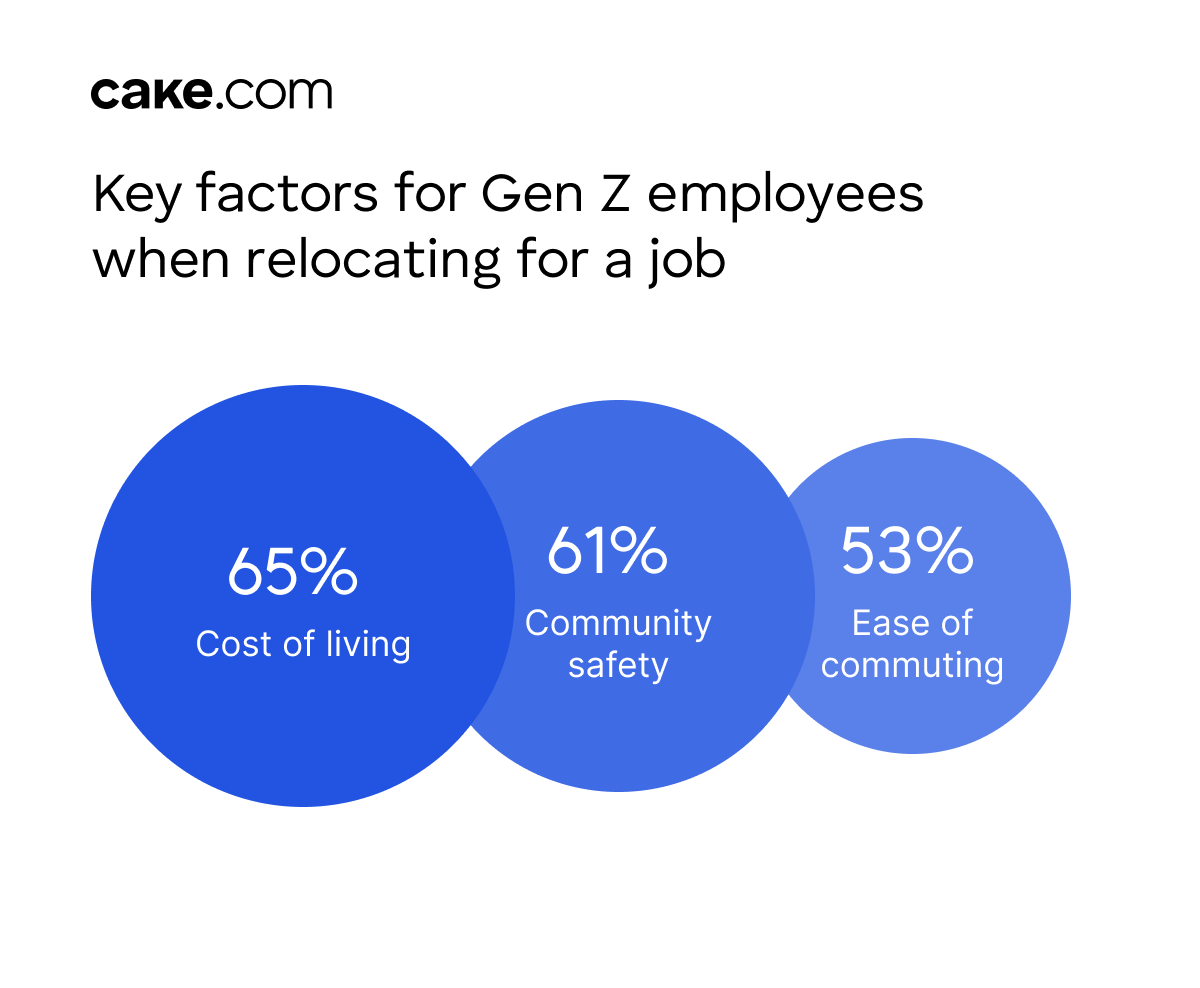
The same report looked at what key factors Gen Zers would consider very important in the event of relocating for a job, with the top 3 being:
- Cost of living — 65%
- Community safety — 61%
- Ease of commuting — 53%
How do higher-ups see Gen Z?
So let’s see what higher-ups have said about Gen Z workers more recently.
Focusing on more recent reports will show whether accusations of a “lack of work ethic” and “unemployability” reflect current leaders’ beliefs or echo past perceptions.
1 in 4 hiring managers believe Gen Z graduates are not prepared for the workplace
A 2025 survey from Intelligent shows that 24% of hiring managers find Gen Z graduates unprepared for the workforce, while 33% claim they lack work ethic.
During interviews, they claim Gen Z graduates have difficulty maintaining eye contact, don’t dress appropriately, and struggle to negotiate compensation. Some candidates are so unprepared that 1 in 10 hiring managers claim they’ve brought a parent to an interview.
45% of hiring managers say Gen Z is the most challenging generation to work with
According to a Resume Genius survey, 45% of hiring managers say working with Gen Zers is so challenging that they plan to hire more Millennials.
What’s interesting is that Gen Z hiring managers feel that exact same way — 45% of Gen Z hiring managers find their own generation the most difficult to work with.
Gen Z hiring managers deprioritize soft skills
According to the 2026 Hiring Insights Report, Gen Z hiring managers rank traditional soft skills like communication, collaboration, critical thinking, and problem-solving lower than other generations. They also place much greater emphasis on AI skills.
| Hiring managers by generation | Communication and collaboration | Critical thinking and problem-solving | AI skills |
|---|---|---|---|
| Gen Z | 35% | 25% | 37% |
| Millennials | 47% | 45% | 26% |
| Gen X | 50% | 55% | 22% |
| Baby Boomers | 70% | 63% | 13% |
Further reading
Age bias is a well-known implicit bias that manifests in the workplace as discrimination based on stereotyping, such as the idea that young workers are lazy and immature. To learn more about workplace biases and how to overcome them, read this guide:
78.9% of managers see regular feedback as an effective motivator for Gen Z employees
According to the latest CAKE.com study, 78.9% of managers have found regular feedback an effective strategy for motivating Gen Z employees. The next best strategy was providing mentorship or coaching (57.9%), followed by offering career development opportunities (31.6%).
Further reading
If you’re about to manage a team of Gen Zers, shying away from giving feedback could only hinder your team’s motivation. See how to incorporate giving constructive feedback into your leadership style:
47.4% of managers claim Gen Zers fostered a more casual atmosphere in their workplace
When asked how the presence of Gen Zers influenced the workplace culture in their organization, 47.4% of managers who participated in the most recent CAKE.com study said they fostered a more casual atmosphere. Their 2 other noteworthy workplace influences include creating a more collaborative environment (26.3%) and emphasizing work-life balance (21.1%).
According to the 2025 Indeed Workforce Insights Survey, workers who are 24 or younger highly appreciate casual dress codes. Interestingly, workers 55 or older feel the same way, while the generations sandwiched between them prefer to keep things formal.
47.4% of managers say Gen Zers adopt AI tools faster than other generations
Another positive thing managers who took part in the CAKE.com study had to say about Gen Zers is that they were exceptional at adopting AI tools:
- 47.4% said Gen Zers adopted AI tools moderately faster than other generations
- 42.1% said they adopted these tools at the same rate
The remaining 10.5% of managers said their teams don’t use AI.
68.4% of managers feel Gen Z employees are eager to learn
We’ve seen a lot of stats about how Gen Zers see themselves as ready to learn and develop new skills and experiences, and that sentiment still holds up when viewed from a manager’s perspective. Namely, as part of our CAKE.com study, we asked managers how eager they feel their Gen Z employees are to learn:
- 52.6% considered their Gen Z employees somewhat eager to learn
- 15.8% found them extremely eager to learn
- 21.1% felt neutral about it
- 10.5% felt their Gen Z employees were not very eager to learn
Scale your business with CAKE.com tools
Increase productivity and grow your organization with Clockify, Pumble, and Plaky.
How can employers attract and retain Gen Z talent?
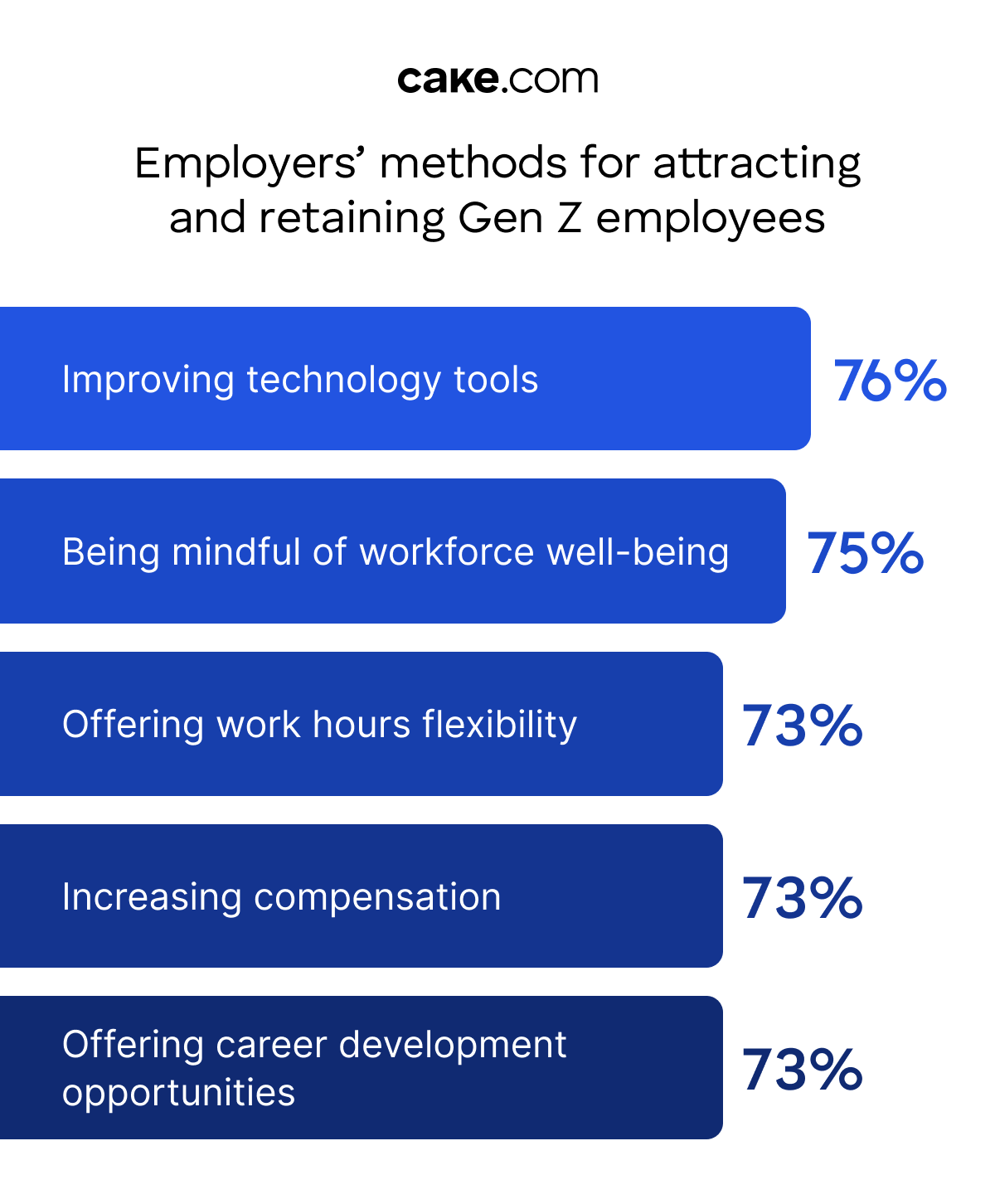
According to Manpower Group’s World of Work for Generation Z 2025 report, employers are doing everything in their power to attract and retain the next workforce generation, including:
- Improving technology tools — 76%
- Being mindful of workforce well-being — 75%
- Offering work hours flexibility — 73%
- Increasing compensation — 73%
- Offering career development opportunities — 73%
This is in accordance with what Gen Zers entering the workforce want from the workplace, based on Deloitte’s 2025 Gen Z and Millennial Survey:
- 86% seek mentorship and guidance
- 88% value on-the-job learning and practical experience for skill development
42.1% of managers say Gen Zers prefer flexible working hours over other benefits
We asked managers which work-life balance perks their Gen Z employees value the most during our CAKE.com study. Flexible work hours topped the list at 42.1%, followed by remote work (36.8%), and strict log-off boundaries (15.8%).
According to the 2025 Indeed Workforce Insights Survey, Gen Z workers value a wider range of benefits compared to other generations, especially Baby Boomers. For example, 32% of 18-to-24-year-olds consider free or discounted food at the workplace a desirable benefit, while this figure is halved for workers who are 65 or older.
Only 45% of Gen Zers have full-time roles
According to Randstad’s Gen Z Workplace Blueprint report, only 45% of Gen Zers hold full-time roles. What’s more, 31% of Gen Zers would like to combine a full-time role with a side hustle. And the reason for this isn’t that they don’t enjoy their full-time role — it’s that they want to gain new experiences, increase their income, and have more control over their career.
The same research shows that the average time spent on the job within the first 5 years of employment is just 1.1 years. The reasoning is the same — Gen Z employees want to grow their experience and careers, which they can’t do by staying in the same role for years.
69% of Gen Zers say technology makes them feel less connected at work
Although they’re digital natives, Gen Zers are aware of the downsides of technology. As per the Freeman 2025 Gen Z Report, a staggering 69% of Gen Zers say technology “has made them feel less connected and more isolated from others at their company/in their industry.”
And 79% of Gen Zers feel like companies focus more on technology to connect people than on building in-person connections.
This could explain why only 2 in 5 Gen Zers express high confidence in networking with people in their industry or building strong business relationships.
At the same time, the CAKE.com study shows that 52.6% of Gen Z employees choose exclusively digital communication tools and online meetings as their preferred method of communication and collaboration. By contrast, 26.3% prefer a mix of digital and in-person interactions, while only 5.3% prefer face-to-face meetings.
The Gen Z impact on the workforce remains unfolding
Having followed Gen Z statistics over the years, one thing is clear — Gen Zers are not static. The statistics change year by year.
To highlight some of the biggest changes:
- Significantly more Gen Zers felt positively about AI in the workplace in 2026 than in 2024
- The Gen Zers who graduated in 2026 used AI twice as much as those who graduated in 2024
- Way fewer Gen Zers placed diversity and inclusion within the top three workplace values in 2026 than in 2024
On the other hand, some statistics have remained mostly static over the years, like Gen Zers being motivated by regular feedback, prioritizing work-life balance more than other generations, and valuing transparency and honesty more than other workplace values.
As Gen Zers continue to make up a larger share of the labor force, understanding these nuances will become essential for leaders who want to effectively collaborate with them. Keeping up with the latest statistics will help leaders recognize these trends and move beyond stereotypes to foster a workplace culture that works for everyone.
Scale your business with CAKE.com tools
Increase productivity and grow your organization with Clockify, Pumble, and Plaky.