Published: April 24, 2026
No volunteers for your next project? No enthusiasm about your ideas, or even pitching their own ideas? Empty desks at 5 PM sharp?
The reason for this kind of behavior might lie in quiet quitting. This silent trend, which has taken over the world, is a productivity black hole, as the final goal is to do the bare minimum.
Why does it happen, and most importantly, how to prevent or reverse it, are the questions of the year.
Our seasoned experts have given us valuable insights based on their experience, together with the latest research.
So, keep reading to learn how to deal with quiet quitting in your team.
- Quiet quitting is the act of continuously providing the bare minimum at work.
- 32% of employees engage in quiet quitting.
- 80% of those who engage in quiet quitting report burnout.
- The term quiet quitting was coined by economist Mark Bolger while speaking at a symposium back in 2009.
What is quiet quitting?
Quiet quitting, also known as soft quitting and silent quitting, is the act of continuously providing the bare minimum at work.
This implies:
- Not coming in early or staying after the shift has ended,
- Not participating in activities or tasks not directly connected to your main job, as well as
- Not showing enthusiasm for work in general.
The term itself was coined by the economist Mark Bolger while speaking at a symposium back in 2009. But the first popular mention of quiet quitting comes from career coach Bryan Creely. Creely posted a video on TikTok in March of 2022, claiming that quiet quitting is about “doing the minimum amount necessary in order to still maintain your position.”
However, China saw its own version of quiet quitting even before this, in 2021 — tang ping (meaning lying flat). China is known for its hardworking and production-oriented culture, so it comes as no surprise that employees wanted to break free from the hustle culture in a Tang Ping movement.
Quiet cracking: The 2025 evolution
The year 2025 brought us another workplace trend called quiet cracking.
Driven by a lack of managerial support and recognition, and fueled by task overload with minimum training or career advancement opportunities, employees quietly lose all of their motivation for work.
Quiet cracking is marked by burnout, dissatisfaction, and unhappiness that build up over time and result in eventual low-quality output.
Unlike with quiet quitting, where disengagement is intentional, with quiet cracking, the employee still wants to perform well, but they’re unable to due to internal turmoil.
How common is quiet quitting?
The 2025 Owl Labs’ State of Hybrid Work report found that 32% of employees engage in quiet quitting. Out of those 32%, 67% are in-office workers, whereas only 5% of remote workers decide to quietly quit.
Since global employee engagement is down to only 20% according to Gallup’s State of the Global Workplace 2026 report, we can conclude that quiet quitting is a trend on the rise.
Further reading:
Learn more about the work trends that are shaping the year 2026 and beyond:
8 manager tips to prevent quiet quitting
Leaders have a lot more responsibility than their employees when it comes to quietly quitting.
For instance, Gallup’s 2025 State of the Global Workplace research shows that a staggering 70% of team engagement depends on the manager. And since the management engagement goes down every year — it is now down to only 27% — we can expect quiet quitting and employee disengagement to thrive even more.
However, it is possible to prevent quiet quitting by taking appropriate action on time. We’ve consulted experts again and compiled a list of the best steps to follow to engage your employees.
Tip #1: Eliminate unnecessary tasks
As a manager, you need to determine which tasks have priority and which ones can either wait or are not important at all.
Leadership Coach Ayanna E. Jackson emphasizes the role of right priorities in the prevention of quiet quitting:

“Everything isn’t important or a priority, but we’re so focused on productivity, especially in light of remote work, that we end up with employees doing the bare minimum – quiet quitting – by nature of our own work practices.”
The goal is to assign your employees the right amount of purposeful tasks they can accomplish within a reasonable amount of time.
Further reading:
Learn about the benefits of time management for managers and employees in this handy manual:
Tip #2: Pay workers what they deserve
Managers must revise the budget and increase salaries of those who deserve them to prevent quiet quitting.
According to the People at Work: A Global Workforce View 2026 research, 62% of employees around the world report working up to 5 unpaid hours a week. Of the remaining 38%, 26% report working up to 15 unpaid hours, and 12% report working 16 hours or more without pay.
Additionally, 27% of employees feel they are underpaid as per ADP’s People at Work 2025 research.
To prevent quiet quitting (and, while we’re at it, the actual quitting), don’t let your employees work without complete pay, or without a raise if they’re your top performers.
Managing Director, Gareth Hoyle, says that employers need to show their staff that they are appreciated and valued:

“I know we’re in the middle of a cost-of-living crisis. But if your workers are on low pay and working really hard, they may want to leave to find better pay elsewhere. If you’ve noticed a decline in work from your workers, you could implement a bonus scheme so that workers receive points each time they do something well, which can equate to money.”
Tip #3: Recognize and praise employees
Managers should regularly praise and reward employees who do their jobs well to build trust and boost morale.
Recruitment Expert Travis Lindemoen emphasizes the power of a simple sign of gratitude:

“Recognize and appreciate your team’s efforts. Sometimes, quiet quitting happens when people feel undervalued. A simple ‘thank you’ or acknowledging their hard work can go a long way in boosting morale and preventing quiet quitting.”
Tip #4: Conduct regular check-ins
Managers should frequently talk to their employees about their future career plans, recent accomplishments, and any potential issues they’re facing. The outcome is employees who are less stressed and more enthusiastic about their work.
For example, a survey by SHRM suggests that regular check-ins help calm anxiety among employees.
Founder of a collaborative platform for teams in various industries, Kraig Kleeman, is convinced that frequent meetings with supervisors — or HR staff — can yield immense benefits:

“Schedule one-on-one meetings with employees to discuss their workload, challenges, and career aspirations. This provides a platform for them to voice any concerns or frustrations and allows you to address issues proactively.”
Further reading:
Find out how to manage your workforce like a pro with our in-depth guide:
Tip #5: Be open and honest with your coworkers
When speaking with your employees, as managers, you should be straightforward and transparent in your communication.
In workplaces where employers don’t offer support to their employees and where they don’t encourage clear communication, employees become disengaged and unmotivated to work.
General Recruiter Viktoria Potapenko thinks that open and honest communication is the cornerstone for resolving problems:

“Engage in clear and frequent communication with your employees. Discuss their concerns openly and express your willingness to support and assist in task distribution. Silent dismissal often evolves from burnout issues.”
Tip #6: Grant time for career development
Managers must provide time for career development, whether it’s in the form of training, seminars, advancement opportunities, or something else.
According to CAKE.com’s 2025 State of the Workplace Statistics, nearly half of employees (45%) would stay with a company because of career advancement opportunities.
Jackson presses on the point that employers need to provide the space for employees to develop themselves:
“Employees are constantly asking for career development, promotions, and skill building. We love stretch assignments. What don’t we love? Giving time to do it. Leadership has to actually give employees the time and space to learn and grow. This means taking 1-2 hours a week to attend the training –– uninterrupted.”
Tip #7: Send employee engagement surveys
Managers, supervisors, and even HR representatives should send surveys on employee engagement and well-being to check the pulse of the workplace atmosphere.
These surveys can be sent out every month or so, to test if widespread disengagement is ravaging their workforce. Such surveys typically include questions on company fit, job satisfaction, motivation, and a sense of purpose.
HR Consultant Rachel Weaven thinks that employee engagement surveys can be a handy tool to check the state of the workforce:

“When companies are busy making products and keeping customers happy, then a ‘quiet’ employee can often be overlooked, which is where engagement surveys come into play. Whilst some people don’t fill them in, there is a chance, as a business, you can monitor the morale and culture of the company through these.”
Tip #8: Understand sick leave patterns
As a manager, you need to monitor the sick leave schemes. If certain employees always take sick leaves close to national holidays, then maybe you are actually dealing with a quiet quitter.
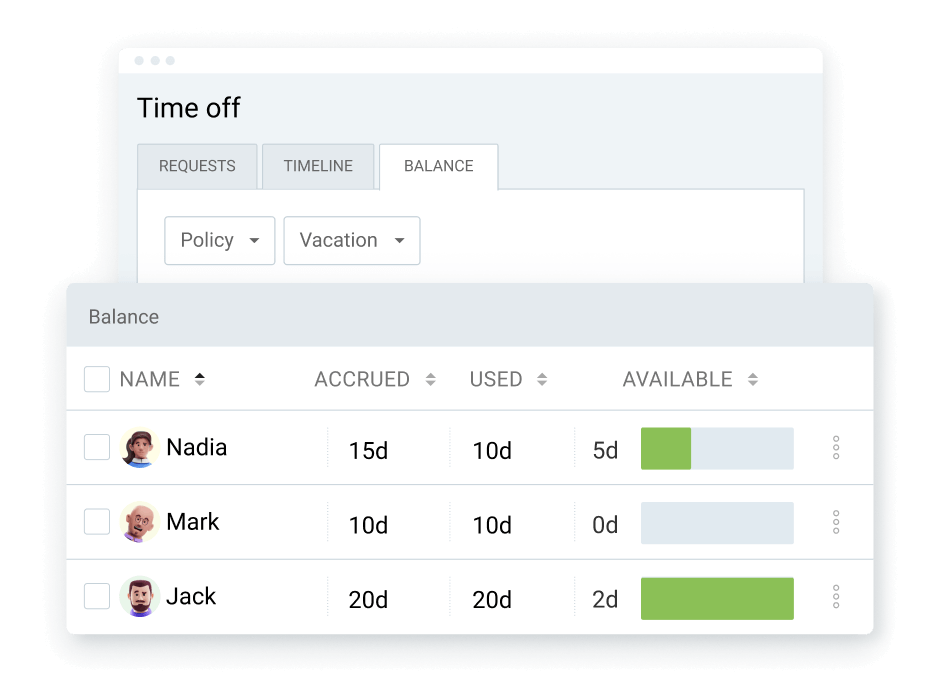
The best way to keep track of all sick leave days without micromanagement is to use time tracking software and create a sick leave policy.
For instance, with Clockify’s PTO and vacation tracker, you’ll be able to set the exact number of days employees can use for sick leave (and other types of leave, too).
Then, simply keep track of the number of sick days an employee takes — and then compare it to others in the company.
Further reading:
Increasing workplace productivity is a pressing issue at companies around the world, so check out this guide for useful techniques on how to do it:
Start tracking time with Clockify today
No more guesswork — boost your team’s productivity by allocating just the right amount of time for each task with Clockify.
Signs of quiet quitting: What it looks like in practice
Quiet quitting directly impacts productivity. According to Gallup’s State of the Global Workplace 2026 research, the world economy lost $10 trillion in 2025 due to the impact of low employee engagement on productivity.
So, it literally pays to notice the quiet quitting signs as early as possible — and address them.
To walk us through some common quiet quitting examples, we spoke to HR reps, productivity experts, and career coaches.
Sign #1: Isolation
A clear sign of team disintegration is when an employee rarely has anything to add during meetings, or they are visibly impatient to see the meeting end.
Similarly, if an employee begins to distance themselves from joint activities, such as eating lunch or engaging in simple conversation, this may be a red flag.
Kleeman reflects on the importance of recognizing when employees are disinterestedly moving away from coworker gatherings:
“Employees who gradually distance themselves from team activities and social interactions within the workplace may quietly quit. They may eat lunch alone or avoid team events.”
Of course, you should make a distinction between quiet quitters and introverts who often avoid socializing with coworkers. The difference is that quiet quitters used to love social gatherings, whereas introverts have avoided them from the very beginning.
Sign #2: Taking longer to do anything work-related
Quiet quitters often need additional time to complete their tasks. So, look out for employees who continuously ask for extended deadlines.
Deadlines are just one piece of the puzzle, though. According to Chris Wong, executive coach and consultant, you should keep an eye out for other signs too:

“Common signs of quiet quitting are taking longer to complete tasks, taking longer to reply to emails/voicemails, and increased absences.”
If the manager keeps on noticing the same issues with failing to meet due dates, then a thorough analysis is necessary to establish the level of employee motivation.
Also, employees may consistently forget to get routine tasks done — tasks they had previously completed diligently.
Sign #3: Employee disengagement
When employees quietly quit, they often only focus on their work.
A part of every modern-age job is to occasionally help out a coworker by volunteering to do a tiny task here and there. Quiet quitters do not engage in these types of tasks anymore, signalling disengagement — a distinctive sign of quiet quitting.
Potapenko thinks that employee disengagement takes many forms:
“An employee experiencing quiet quitting no longer strives to excel, assist colleagues, or prove themselves as a valuable team member. Additionally, they do not converse with their manager about their future career ambitions.”
Even more specifically, not speaking up during team meetings could be a sign of quiet quitting.
Kleeman finds that managers can notice subtle quiet quitting signs by checking whether the employee has lost interest in their work:
“A decrease in asking questions or seeking clarification on tasks can indicate that an employee has lost interest in their work. They may go through the motions without trying to understand the bigger picture.”
Sign #4: Taking an unusual number of sick days
When an employee softly quits, they sometimes take an unreasonable amount of sick days. In turn, this results in employee absenteeism — habitual absence from work.
Simply put, an employee may be dishonest about how many sick days they actually need to recover, over and over again.
Human Resources Generalist Ena Popović believes that a manager can tell if an employee is misusing their sick days:

“A worker taking sick leave far more often than the rest of their colleagues may be a sign of quiet quitting. They also may avoid speaking about their current health. Also, a continued poor quality in work produced — such as decreased productivity and proactivity — before taking sick leave can be a telling sign.”
But things don’t end here. Popović thinks that managing emotions is equally vital:
“Emotional distancing from work and a lack of motivation to acquire new knowledge and skills can also constitute red flags.”
Sign #5: Former enthusiasts turn into passive employees
Enthusiasm isn’t required to do your job well. Yet, it can be a useful trait as it motivates employees to perform better.
To that effect, Kleeman believes that the shift from a proactive to a passive employee happens in a flash:
“A simple, rather blatant example of quiet quitting could be an employee who used to be proactive in seeking out new projects and challenges but has recently become passive, only doing what is explicitly assigned to them. They no longer volunteer for extra tasks or contribute innovative ideas to improve processes, showing a lack of enthusiasm for their role.”
Sign #6: Frustrated employees turn into perfectionists
Quiet cracking is accompanied by elevated stress in employees, so pay attention to frustrated employees who are turning into perfectionists.
These employees want to receive recognition from their managers, so they work hard to achieve it. However, since this recognition never comes, they begin to crack and disengage from the company, as well as from other employees.
Still, they want to thrive in what they do — until they finally quit their jobs, that is. This makes quiet cracking a bit harder to spot, but when you know what you’re looking for, it becomes much easier.
Why is quiet quitting so prevalent today?
Let’s find out what causes quiet quitting so that we can understand it better.
Poor management engagement
When managers aren’t engaged at their workplace, the outcome is seen as disappearing employee engagement.
According to Gallup’s State of the Global Workplace 2026 report, employee engagement dropped to a mere 20% in 2025. Gallup links low employee engagement to low manager engagement, which fell sharply from 27% in 2024 to 22% in 2025.
Lack of recognition
The 2026 study Quiet Quitting as Compensatory Respect: Meaningful Work, Recognition, and the Entrepreneurial Ethic, found that one of the main reasons for quiet quitting is “workers’ experiences of being under-appreciated, unconsulted, and overlooked in the management of workplaces”.
Absence of career development
Career development opportunities are another root cause of quiet quitting. As per Gallup’s American Job Quality Study 2025, in smaller companies, only 1 in 3 employees has advancement opportunities.
Additionally, less than half of employees (45%) report having training sessions for acquiring new skills, and the opportunities are mostly reserved for employees with a formal education and a degree.
Burnout
A staggering 80% of those who engage in quiet quitting report burnout, as a 2025 study about quiet quitting and burnout found out.
It is important to note that in this case, the quiet quitting is not intentional; rather, it becomes a coping mechanism to preserve one’s mental health.
Gen Z’s attitude toward work
Gen Z has only begun to dominate the workforce and reshape it so that it fits the work/life image they desire. And working overtime, not being paid enough, and a lack of recognition do not fit into Gen Z’s agenda.
According to the Factors Causing Quiet Quitting in Generation Z 2025 study, Gen Z employees are quiet quitting as a strategy to battle work pressure and work-life imbalance. They’re not lazy — they just don’t want to make work the pivotal part of their lives.
Further reading:
Find out more about Gen Z statistics and facts right here:
Elevate productivity with CAKE.com
Combine time tracking, team communication, and project management to boost your organization’s productivity — with the CAKE.com Suite.
Quiet quitting vs quiet firing vs quiet cutting
Quiet quitting is as real as its dark counterparts: quiet firing and quiet cutting.
In simple terms, quiet quitting is all about:
- Interacting with fellow coworkers only when necessary,
- Avoiding fully taking part in meetings, and
- Doing the bare minimum at work.
But unlike quiet quitting, quiet firing and quiet cutting means the company is going after the employee. In other words, it’s the manager, supervisor, or employer who is actively working to create unbearable work conditions.
Let us illustrate.
Quiet firing is about giving the employee minimum benefits and wages to force them to quit voluntarily. So, the manager or employer makes the job so unrewarding that the employee has no other choice but to leave. Less obviously, an employee in this situation will likely get passed over for a well-deserved promotion.
With quiet firing, employers intentionally create a hostile work environment to drive employees out. In fact, some companies have recently made headlines for their practice of quiet firing.
Sadly, many employees don’t see it coming. As a result, they find themselves in a difficult situation when it happens.
Quiet cutting, on the other hand, means that a company reassigns its current employees to roles that don’t exactly fit their skill set. The goal? To push workers into performing work tasks that the company needs to reduce hiring costs — without any care for the employee’s needs.
For example, a manager may inform an employee that the company has eliminated their job role. Yet, they go on to say that the employee is staying in the company and given a day or two to choose between a few equally unfavorable job titles for the same pay.
With quiet cutting, companies aren’t really laying off personnel, but they are cutting their costs for sure. As a result, workers are pushed into miserable working conditions.
| Trend | Who does it | What it looks like |
|---|---|---|
| Quiet quitting | Employee | Doing the bare minimum at workPoor participation in meetingsInteracting with other staff only when necessary |
| Quiet firing | Employer/Manager | Not providing rewardsPassing employees over for promotionsCreating a hostile work environment |
| Quiet cutting | Employer/Company | Reassigning current employees to worse positionsPushing workers into miserable work conditionsCutting costs as the ultimate goal |
FAQ about quiet quitting
Here are the answers to some of the most frequently asked questions about quiet quitting.
What triggers quiet quitting?
The single biggest trigger for soft quitting is job dissatisfaction.
Job dissatisfaction usually stems from a lack of employee recognition. Working a lot without praise or a path forward leads to employees choosing not to invest themselves as much.
Is quiet quitting intentional?
Quiet quitting is a coping mechanism that is created out of a long-term, toxic work atmosphere.
Strategic HR advisor Tim Toterhi thinks that quiet quitting is definitely a willful decision to act in certain ways:

“Quiet quitting is the act of doing exactly what you were hired to do as promised — no more, no less. It’s a matter of opportunity cost. An employee can work more for free and hope for an eventual reward. Or they can devote that extra time to family, friends, hobbies, or a side hustle that actually pays.”
Is quiet quitting actually laziness?
When the recent pandemic triggered quiet quitting among those below 35 — Millennials and Generation Z — elderly workers thought of it as mere laziness. Yet, there’s more to it than meets the eye.
In fact, a 2023 research article on reimagining quiet quitting suggests that quiet quitting was “an enhanced way of dealing with job stress, disengagement, and burnout.”
Quiet quitting is not about being lazy. It’s a silent, but powerful, wake-up call to companies to boost their management.
What is the quiet quitting period?
Quiet quitters don’t become quiet quitters overnight. It happens over weeks or months of piling up dissatisfaction with various areas of work.
But when it starts, the end often isn’t in sight.
Toterhi says that quiet quitting doesn’t have a specific expiration date:
“There is no set period. Employees quietly quit as soon as they realize that many companies have devised HR processes to take advantage of employees. They hire you for a role and immediately expect you to do more than they pay you for. Check your job description. No doubt, you’ll see a convenient phrase listed in the responsibilities section — the old ‘other duties as assigned.’”
Reverse quiet quitting and level up your productivity
Disengaged employees aren’t good for productivity or profitability — we’ve all seen the stats.
But there is a way out of this, and it’s paved with recognizing your employees’ efforts, offering them career advancement opportunities, and not overburdening them.
Soon enough, you’ll notice more raised hands during meetings, new ideas and solutions surging, and higher productivity levels.
Because when employees feel appreciated, they’re not quietly quitting — they’re loudly successful at what they do best.
How we reviewed this post: Our writers & editors monitor the posts and update them when new information becomes available, to keep them fresh and relevant.