Published: February 11, 2026
Maintaining a positive attitude at work is something that’s in your best interest to do because it really does pay dividends.
Research shows that positive people tend to be more successful, get favorable performance reviews, and even have higher salaries.
And you might think “well duh, of course they’re more positive when they have higher salaries,” but that’s not the sequence of events here.
Positivity precedes success!
And the best thing is — a positive work attitude is a skill that can be learned.
- Employees with a positive attitude have higher job satisfaction and greater career success.
- Organizations with positive employees have lower turnover rates and increased adaptability to change.
- You can become more positive by focusing on building hope, efficacy, resilience, and optimism.
- Leadership should adopt a positive attitude because workplace positivity is contagious even in a global setting.
The benefits of having a positive attitude at work
The benefits of workplace positivity extend to both individual employees and entire organizations.
On a personal level, these benefits include:
- Improved well-being,
- Higher job satisfaction,
- Greater career success, and
- Enhanced goal attainment.
For organizations, the benefits of workplace positivity include:
- Reduced turnover,
- Enhanced performance,
- Increased adaptability to change, and
- Higher organizational commitment.
The tips we’ve prepared will help you strike a more positive attitude at work to realize these benefits.
But first, let’s get on the same page about what positivity in the workplace means, since you definitely want to avoid toxic positivity.
Elevate productivity with CAKE.com
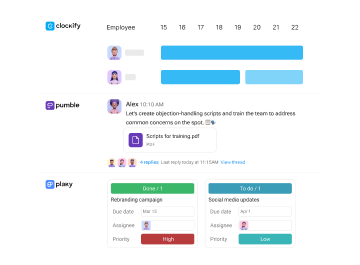
Combine time tracking, team communication, and project management to boost your organization’s productivity — with the CAKE.com Suite.
What exactly does having a positive attitude at work mean?
Workplace positivity (also known as psychological capital in psychological literature) comprises these 4 traits:
- Hope — knowing that there is a way out of a bad situation. It may be difficult, but it exists.
- Efficacy — understanding that you’re capable. You’re good at your job, you’ve accomplished difficult tasks before, and you can do it again. So when there’s a way out of a bad situation, even if it’s difficult, you feel that you can wade through it!
- Resilience — being able to recover from a slump. Everyone experiences setbacks and failures. Being resilient means being able to bounce back quickly and, ideally, even better than you were before because you’ve learned from the experience.
- Optimism — feeling that things will be alright and that setbacks are temporary. This isn’t delusional optimism where you expect tasks you’ve never done before will be a breeze. It’s optimism grounded in competence. When you do well, you give yourself credit. When you miss the mark, you see that as a challenge you can fix, not as a permanent flaw in yourself.
How to have a positive attitude at work
To strike and maintain a positive attitude at work that will enhance your career growth, you should focus on the 4 traits outlined above.
So, that’s what I’ll focus on with these tips.
This isn’t to say that general advice for being more positive — like smiling more and treating people with kindness — is wrong!
But hope, efficacy, resilience, and optimism are the traits used to define workplace positivity in all the research that resulted in the benefits I listed.
By contrast, the benefits of being nice are anecdotal.
Choose who you interact with
If your closest colleagues are chronic complainers who love office gossip, you’ll find it impossibly difficult to maintain a positive attitude — even if you don’t actively contribute to the gossip or complaining.
That’s because their negativity is contagious.
But the good news is that positivity is also contagious, so you can increase your positivity by choosing the right company.
Replace those complainers who are holding you back with more productive and constructive company. Ideally, you should surround yourself with the so-called positive persuaders — colleagues or mentors who give genuine, constructive feedback and verbal encouragement.
Doing this will make you positive by decreasing hopelessness and increasing efficacy.
Don’t fall victim to victim mentality
Nursing a victim mentality at work means having no hope. Bad things are happening to you (they’re never your fault), and there’s nothing you can do about it except complain.
But that’s not true — you can do something about it.
Start by shifting your language.
Instead of saying “It’s not my fault,” ask “What part of this situation can I influence moving forward?”
Victim mentality thrives when you focus on things outside your control, so spend more energy on things within your control.
You cannot control the economy or your boss’s mood, but you can control your efforts, reactions, and boundaries.
Lastly, replace complaining with requests.
If you’re swamped with 5 high-priority tasks, take this up with your manager and ask which tasks you should de-prioritize so that you can do the remaining ones well.
Doing this will increase hope and efficacy.
Embrace feedback and failure
Did you lose a client? Well, don’t celebrate that — but don’t fall into an existential crisis either.
Do the positive thing (and, frankly, the only productive thing) — treat failure as a growth and learning opportunity!
Analyze what happened. Could you have prevented it? Try to find a solution and apply it going forward.
You don’t have to do this alone. Ask your colleagues for feedback. They may well spot flaws or inefficiencies in your work patterns that you subconsciously turn a blind eye to.
And when you do this, don’t take feedback personally. Feedback is not an attack on your personality — it’s advice on improving at your job. If your goal is to do the best job that you can, you should treat feedback as the precious gold mine for career advancement that it is.
This is how you build resilience.
Further reading
Giving constructive feedback is just one way to cultivate positive communication at work. For more tips, read this guide:
Process frustration first, then reframe your mindset
When you hit a snag in your projects, give yourself a maximum of 24 hours to feel the frustration.
Once your psychological state returns to its baseline, shift the focus to what you’re going to do next. Frustration first, solutions second.
Why a maximum of 24 hours?
The exact timing changes from individual to individual, but research shows that trying to reframe the situation too early isn’t an effective way of regulating emotions.
In science speak, you have to wait for the amygdala to stop being highly active before your prefrontal cortex can take over and do the reframing.
In everyday language, trying to suppress or reframe emotions while in “the heat of the moment” is less effective than giving yourself a bit of time to calm down first.
This is another tip that will increase your resilience, since resilience isn’t just about bouncing back quickly, but bouncing back stronger.
Prioritize your well-being
Actual positivity requires maintenance.
Take breaks. Recharge your batteries. Spend time with friends. Have fun with your hobbies. Fix your work-life balance.
Basically, get out of the mindset that, if you aren’t working, you’re not being productive. Time does not equal productivity.
If you want to have a positive attitude, you need to keep your psyche healthy, since maintaining a positive attitude if you’re burned out is impossible. That’s because burnout impairs the brain and its ability to down-regulate negative emotions.
So while this won’t directly help build hope, efficacy, resilience, or optimism, it’ll make you more receptive to them.
Further reading
What can feel like burnout is sometimes just overstimulation. Lucky for you, this guide will show you how to handle it:
Leaders: Lead by example
If you’re a manager or otherwise in a leadership position, you need to understand that your attitude and behavior aren’t just a thermometer for your positivity — they’re the thermostat for the whole team.
As mentioned, positivity and negativity are both infectious. But you get to choose the mindset you model.
If you always stay up late and burn yourself out to do more, your team members will feel like that’s expected of them as well.
Demonstrate positivity instead. Lead by example. Follow the previous tips and be seen following them.
I’m not basing this on vibes or how I think things work based on my common sense. Research on the contagion effect of positivity shows that when a leader is high in psychological capital (positive attitude defined by the hope, efficacy, resilience, and optimism), it rubs off on other employees even in a global company.
So this kind of positivity doesn’t even need in-person interaction to be contagious.
Regular employees can apply these tips to get the individual benefits, but it takes someone in a leadership position modeling this type of behavior and positive attitude to maximize the benefit at the level of the company or team.
Leaders: Promote psychological safety
Let everyone at your company or in your team know that they won’t be punished or face any kind of retaliation for voicing opinions, making suggestions, or offering criticism.
That’s what psychological safety means!
It’s not like physical safety — which is not being put in physical discomfort. Psychological safety means feeling safe to put yourself in uncomfortable situations.
Pointing out the flaws and risks in your leader’s plan, suggesting changes, taking chances — these aren’t pleasant activities, but they’re what success is built on.
So let people know that, under your leadership, these things will be rewarded — not punished. This is essential for workplace positivity to flourish.
Further reading
Demonstrating positivity and promoting psychological safety are essential, but there’s more you can do to create a positive work environment at your company:
Improve your attitude to also improve your career
Usually, things that are good for us tend to be uncomfortable and unpleasant.
You wanna be fit and healthy? Well, you gotta eat well and excercise…
You wanna be an expert in your field? Better hit the books and face your ignorance!
But if you want to improve your career prospects, you should develop a positive attitude by being hopeful and optimistic, confident in your capabilities, and not dwelling on setbacks?
That sounds awesome!
So use these tips to develop a positive attitude at work — you’ll enjoy both the process and the results.
Elevate productivity with CAKE.com
Combine time tracking, team communication, and project management to boost your organization’s productivity — with the CAKE.com Suite.