Published: March 12, 2026
Heard that Millennials and Gen Zers want to work with companies that have strong corporate social responsibility?
Hope adopting this will be your ticket to winning the talent war?
Not a bad idea, but tricky to execute properly.
After all, only 9% of consumers believe all corporate claims about social responsibility. So you’ll want to avoid having your CSR strategy come across as insincere greenwashing.
How do you do this right?
That’s what this article will help you figure out.
- Corporate social responsibility is no longer optional — recruits won’t work for you if your ethics don’t align with theirs.
- Inauthentic CSR efforts can have negative effects if the public sees them as mere marketing stunts or greenwashing attempts.
- Authentic CSR brings many benefits, including cost savings and attracting investors.
What is corporate social responsibility — and why should you care?
Corporate social responsibility is a self-regulating business model that prioritizes harm reduction and environmental sustainability.
In practical terms, this means a socially responsible company should:
- Comply with legal regulations, norms, and standards,
- Provide its workers with fair working conditions,
- Establish positive relationships with local communities, and
- Reduce its environmental impact by minding its carbon footprint and optimizing its supply chain.
To a cynical businessperson, this may seem like just an expense or a liability, but the ROI for doing this is substantial.
As Sangeeta Waldron, founder of Serendipity PR & Media, tells us, authentic CSR: “[C]reates authentic brands, creates consumer engagement, and avoids greenwashing and crisis management.”
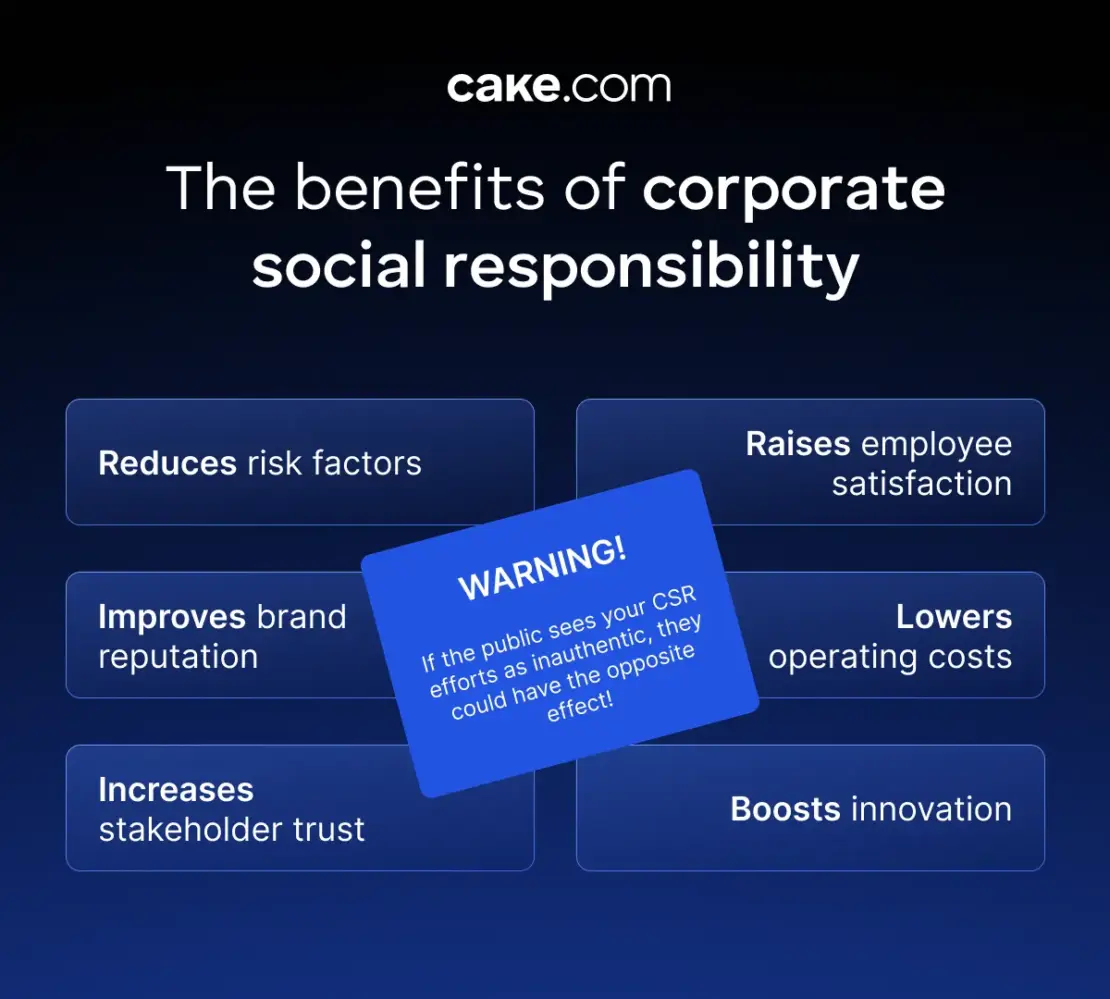
The benefits of (proper) corporate social responsibility
As I’ve already alluded to in the introduction, corporate social responsibility is one way to attract young talent. A recent Deloitte 2025 Gen Z and Millennial Survey shows that young workers aren’t just after money — they’re seeking the trifecta for career fulfillment: money, meaning, and wellbeing.
Take Gen Z, for example — 89% of this generation says that purpose is essential to their job satisfaction. In fact, 44% have already rejected employers because their company’s values or ethics didn’t align with their own. For Millennials, these digits are 92% and 45% respectively.
But that’s far from the only positive outcome of corporate social responsibility. We’ve asked experts to share the benefits they’ve noticed in their experience with CSR strategies.
If you’re having trouble convincing your board to back up your CSR initiative, try explaining these benefits to them.
Further reading
Check out these statistics to learn more about Gen Z in the workplace:
#1 Risk management
While risk management shouldn’t be the primary driver of your company’s CSR initiatives, as consumers are quick to sniff out disingenuous stunts like that, it’s still a benefit you’ll enjoy regardless.
As Brenda Christensen, CEO of Stellar Public Relations, put it:

“CSR initiatives can help mitigate potential risk and controversies related to environmental or social concerns.”
After all, by genuinely committing your company to act ethically and preserve the environment, you’ll automatically be on track to avoid certain controversies, or at least minimize them.
Patagonia showcased this when they publicly disclosed their supply chain and its ecological impact. So, when they got accused of using live-plucked down, they didn’t scramble or deny it — they fixed it.
What’s more, Amy Spurling, Founder and CEO of Compt, points out that “[p]roactively addressing societal and environmental issues can help companies avoid potential legal or regulatory pitfalls down the road.”
#2 Positive brand reputation
Christensen points out the following:
“Positive CSR efforts lead to a better brand image, making companies more appealing to consumers and potential employees.”
Spurling also adds that “companies known for their CSR initiatives are often more respected and admired. This can lead to greater customer loyalty and brand differentiation.”
Any way you slice it, authentic CSR efforts generate goodwill that advertising just doesn’t buy.
#3 Stakeholder trust
A positive brand reputation that comes from successfully executing various CSR initiatives increases the trust people across the board have in your company.
We’ve already mentioned how CSR builds a better image for consumers and potential employees, but according to Christensen, this includes stakeholders and shareholders as well. It can even increase the sense of trust in your company among suppliers, local communities, and governments.
And, as the final cherry on top, CSR makes your company more appealing to investors. As Waldron put it: “[Corporate responsibility] attracts investors because businesses with authentic CSR are low risk.”
#4 Employee engagement and satisfaction
In a world where only 21% of employees feel engaged at work, anything that nudges that number up is a blessing.
And, according to Amy Spurling, CSR initiatives will do just that, especially when it comes to younger employees.

“Employees, especially the younger generation, want to work for companies that align with their values. CSR initiatives can boost morale, job satisfaction, and loyalty.”
In practice, this translates to not just higher employee engagement and satisfaction, but also better retention and talent attraction, since it draws candidates with similar values to those of your company.
#5 Cost reduction
That’s right, not only is CSR not a money sink — it actually saves money.
According to Bob Willard, an expert in corporate sustainability and author of The New Sustainability Advantage, companies that incorporate CSR into their business strategy can increase their profits by 51-81%, depending on the size of the company.
The reasons for this are threefold:
- CSR initiatives often come with tax incentives.
- CSR garners customer loyalty, which translates to long-term financial gains.
- CSR programs often result in higher energy efficiency and waste reduction, which reduces spending.
If you’re having trouble convincing the board that “doing good” is good for business, tell them what the benefits are.
#6 Innovation
Last but not least, companies that practice social and environmental responsibility often become industry leaders and innovators in their fields.
CSR strategies are a limitation in how you can approach certain things, but it’s the kind of limitation that breeds creativity.
For example, Honda and Toyota have announced their commitment to create electric vehicles that run on solid-state batteries instead of the usual lithium-ion batteries, which aren’t a sustainable source of energy.
Without CSR, this kind of innovation would not have happened.
But once you reconsider the way you hire and manage employees, source products and resources, or even how you bring value to your customers, you can arrive at all kinds of innovative breakthroughs that can help you stand out in the market.
4 types of corporate social responsibility
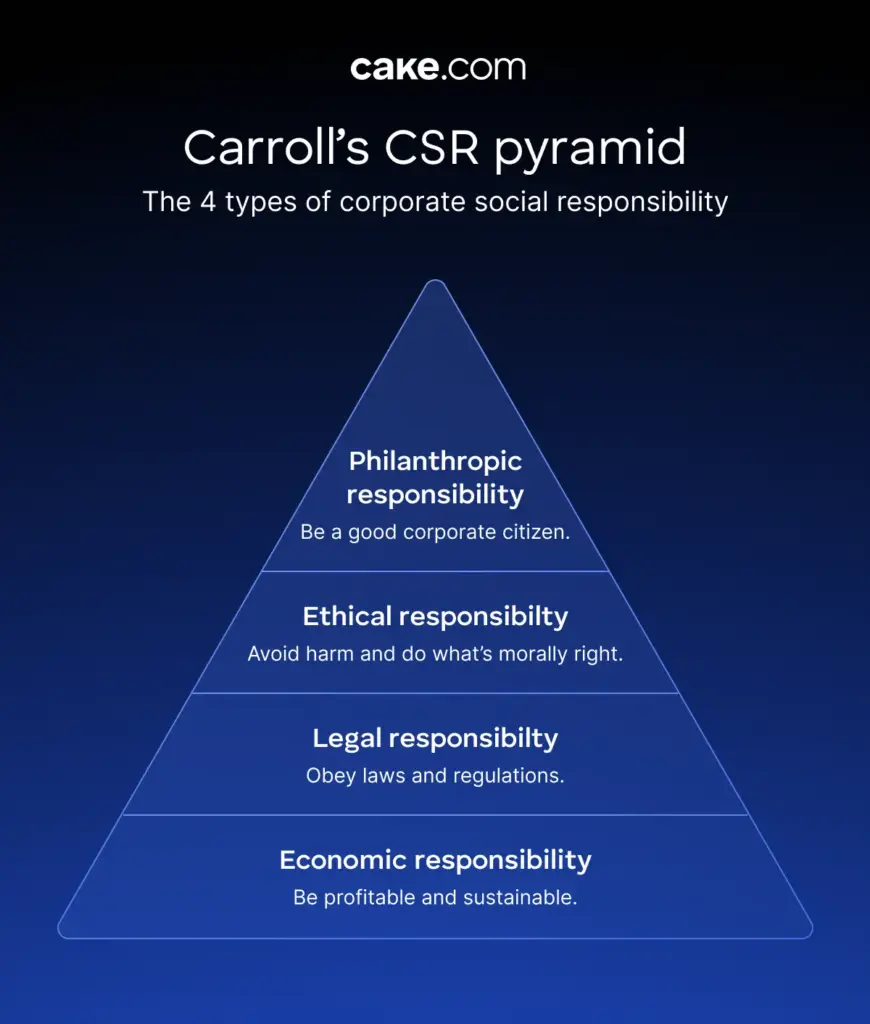
According to Archie Carroll’s pyramid of corporate social responsibility, companies have these 4 types of corporate social responsibility. He ranks them in this order:
- Economic responsibility — being economically profitable,
- Legal responsibility — obeying the law,
- Ethical responsibility — being ethically responsible, and
- Philanthropic responsibility — donating to philanthropic causes.
This is the original CSR pyramid from 1991. Admittedly, the corporate social responsibility definition has changed over the years. Nowadays, most businesses use the modern version, which places economic responsibility at the bottom and renames legal responsibility into environmental responsibility.
But here’s the thing about the modern corporate social responsibility definition — no one buys it.
According to a survey by Certus Insights, only 9% of consumers believe all corporate claims about social responsibility.
A whopping 62% of consumers believe companies are greenwashing — making environmental claims that are either exaggerated or just plain false.
And it’s not just consumers; merely 38% of employees believe their employers are doing enough to address climate change.
No one really thinks that profits are at the bottom of a company’s priority lists, so let’s just stick with the honest and reasonable interpretation of the types of CSR, shall we?
After all, the aforementioned benefits of corporate social responsibility only work if the public sees your efforts as authentic. If you come across as inauthentic, they can have the opposite effect!
#1 Economic responsibility
A company’s primary responsibility is to be profitable.
This may seem irrelevant for CSR, but it’s not. Profits allow businesses to sustain themselves, which, in turn, allows them to participate in the other responsibilities that we think of when we think about CSR.
Consumers are all aware of this — it’s why most don’t buy the false narratives of putting the planet first. And it’s not necessary to try and gaslight them — or yourself — that the situation is different.
After all, without profits, there could be no philanthropy. And a business that goes bankrupt and closes can’t benefit anyone with its impeccable ethics.
So consider the economic responsibility a part of your CSR; just frame it within a genuine legal, ethical, and philanthropic context.
#2 Legal responsibility
A corporation’s legal responsibility is to obey local, state, and federal laws and obligations.
The reason the modern framework renamed this responsibility from legal to environmental is that most people consider obeying the law to be a given. Plus, the ESG reporting already places a lot of compliance emphasis on the environment, so it just sounds more appealing.
But, while legal responsibility includes environmental compliance, it covers more than that. It includes things like:
- Employees being protected from abuse and treated fairly,
- Consumers receiving goods and services that meet legal requirements, and
- The environment being minimally affected by the company’s operations (as required by the law).
#3 Ethical responsibility
People expect companies to behave according to evolving societal morals, even though behaving ethically in ways that go beyond legal compliance isn’t necessary.
After all, laws — unfortunately — sometimes leave a lot of leeway for bad actors to spread their wings.
Ethical responsibility means going the extra mile beyond what’s legally required, such as:
- Expanding employee benefits,
- Reducing environmentally harmful practices,
- Seeking out ethical and sustainable suppliers, and
- Disclosing any operating concerns to stakeholders in a timely, honest, and respectful manner.
Businesses with physical supply chains often pursue ethical responsibility by following Fair Trade Standards. But digital businesses aren’t without options. Something like the IEEE Global Initiative on Ethics of Autonomous and Intelligent Systems can serve as its analog.
#4 Philanthropic responsibility
Finally, there’s philanthropic responsibility. It might be difficult to separate it from ethical responsibility at first glance, so let’s clear up the distinction.
A good example of ethical responsibility in this CRS model would be a company not using sweatshop labor even in countries where using it is legal. These behaviors are expected in the eyes of consumers.
Philanthropic responsibility, on the other hand, covers things for which the general consumer has no expectation, things like:
- Giving charitable donations,
- Sponsoring fundraising events,
- Offsetting the company’s negative environmental impact through volunteer actions (like planting trees), and
- Funding targeted research.
The demand for CSR is higher than ever
While the modern CSR pyramid is disingenuous, it does at least reflect the demands of consumers toward companies.
Back when Carroll made this CSR pyramid, philanthropic responsibility was seen as optional — something that not all companies were expected to take part in. However, this no longer seems to be the case.
According to the Certus Insights survey, 70% of consumers want to know what companies are doing to address social and environmental issues, with 73% having the same expectations from small companies.
This was in 2019. Things have intensified since then.
A 2025 study from Getty Images found that 82% of consumers want companies to have clear ESG guidelines and practices, while 75% want visual proof of how companies are addressing climate change and other social responsibilities.
Saying that ethical and philanthropic efforts are becoming increasingly important considerations in the eyes of consumers is an understatement.
Examples of corporate social responsibility
Let’s go through some famous examples of corporate social responsibility so that you can see how this looks in practice.
#1 Patagonia
Patagonia, the outdoor clothing and gear company, has set the gold standard for environmental activism.
Their sustainability page doesn’t just display how they’re committed to making a change, but also the actual progress they’re making toward these commitments, like:
- More than 90% of their products now being made in Fair Trade Certified factories,
- Completely phasing out products with intentionally added PFAS, and
- Using 100% traceable virgin down.
They also have their Worn Wear program, where customers can trade-in old products for in-store credit or get them repaired. This circular business model promotes reuse over just producing, with the company boasting the largest garment repair center in North America.
According to research, these CSR efforts have greatly increased brand loyalty toward Patagonia, making this one of the best examples of corporate social responsibility done right.
#2 IKEA
Then there’s IKEA. The company we know as a sustainability giant today actually faced 2 massive PR disasters — one with dangerous emission levels in a bookshelf in the 80s and the other with child labor in the 90s.
So what did IKEA do?
Well, instead of just fixing the bookcase, they forced every supplier worldwide that wanted to keep IKEA as a client to meet the German E1 emission standard.
As for the child labor issue, in addition to partnering with UNICEF, IKEA funded the education of the affected children. They refused to restart work with a supplier until they could prove the child enrolled.
Their sustainability page outlines other strategies that they are pursuing, but I wanted to focus on these 2 major PR disasters to show an example of CSR being able to completely flip your brand’s public perception in your favor.
Keep your CSR efforts authentic to make them worthwhile
CSR talk tends to be heavy on corporate speak — big words that seem to just go in circles or operate in abstractions.
But that doesn’t help you actually set your own CSR strategy. Nor does it help that companies like to parade their supposed virtue with hyperboles and blatant lies — like profitability being their last priority.
So I hope this article, overly blunt though it may have been at times, has helped you actually make sense of what CSR is and how everyone — your company included — stands to benefit from it.
You don’t need to make lofty commitments you know are impossible.
Just keep it authentic, focus on areas relevant to your business (just like IKEA and Patagonia did) instead of throwing money at the hot new charity fad for the sake of marketing and publicity.
This is the kind of CSR that will win you the talent war, attract investors, and build brand loyalty.
How we reviewed this post: Our writers & editors monitor the posts and update them when new information becomes available, to keep them fresh and relevant.