Published: July 20, 2026
Constant messages on team chat apps, hyper-availability during and after working hours, and ad hoc meetings and phone calls represent an endless stream of modern-day workplace interruptions.
These workplace interruptions are a financial, energy, and productivity drain for both employees and companies alike.
Let’s dive into more details on the consequences of constant interruptions and how to best implement the do-not-disturb culture at your workplace.
- US businesses lose approximately $650 billion a year due to distractions.
- An office worker is interrupted on average every 3 to 11 minutes.
- To help ensure employees aren’t interrupted as much, Pumble offers pausing notifications and setting appropriate statuses, such as Deep work.
- Communication should not be eliminated, but it should be made more intentional.
Interruptions have become normalized
All around the globe, employees are faced with the struggles of responding to countless interruptions during the day while trying to produce high-quality work at the same time.
VP of Human Capital at CAKE.com, Biljana Rakić, explains that workplace values are currently turned upside down:

“We live in a culture that glorifies hustle, where working overtime and answering emails late at night are often seen as badges of honor and proof of loyalty to the company. However, this is a dangerous misconception.”
The reality of an intense workplace often contradicts the necessity for deep thinking and creative work.
Founder and Leadership Coach at Discover Freedom, Brittany Blackman, remembers her days used to be filled with constant interruptions:

“Over the years, I’ve worked in fast-paced environments where messages, phone calls, walk-ups, emails, and “quick questions” were happening all day long. The grind was real and was rewarded. While each interruption may seem harmless on its own, the cumulative effect can be significant.”
But why do people even feel obliged to respond to everything around them? The answer may very well lie in FOMO (Fear of missing out).
To illustrate this, business strategist at On Call COO company, Melissa Franks, shares an example of a business she worked with, where employees lived in constant fear of missing out:

“Everybody was so afraid of ‘missing something’ that deliverable timelines were often missed, low-quality output was delivered, and the team was distracted and frustrated.”
When employees are interrupted, the company pays for it
Even if it seems that constant messages, meetings, and phone calls are harmless, the truth is reflected in financial statements. As cited in a Clockify article on workplace distractions shows that US businesses lose approximately $650 billion a year due to distractions.
While this digit may seem unrealistically high, it stops being so once you realize that, according to Pumble data, an average worker receives more than 70 messages from team chat apps every day. This is without even taking ad hoc meetings, emails, or water cooler conversations into consideration.
But being interrupted is just one piece of the puzzle. Interruptions can last only for a few seconds (at best), however, regaining focus is the truly tricky part. Research shows that it takes 25 minutes and 26 seconds to regain focus after a distraction.
The financial strain becomes the end result of poor daily practices, and employees become casualties in the fight for focus.
Further reading:
For more information on workplace distraction statistics, read the following article:
Effortless communication begins with Pumble
Enjoy unlimited chat history, threads, public and private channels, high-quality video calls, and more.
The consequences of a shattered focus from a psychological perspective
Lost focus impacts internal processes. It ultimately leads to a lower quality of tasks that are performed with interruptions, because of not having enough space to think and work on those tasks. Here’s how Clinical Psychologist at Lakes Behavioral Health company, Dakari Quimby, explains this:

“From a behavioral psychology perspective, constant interruptions train employees to expect and respond to stimuli immediately, similar to the same variable reward system that causes people to check their devices for an immediate dopamine hit. This can ultimately reduce deep thinking, creativity, problem-solving, as well as higher-level insights due to the brain being rarely engaged in one challenge long enough to reach those levels of insight.”
Not having enough space to think and work on some tasks is inevitable because of something called attention residue, as coined by Sophie Leroy in 2009. Leroy found that, when people switch to a new task, their brains are still processing the old task, so they can’t truly focus on that new task. Given the statistics that an office worker is interrupted on average every 3 to 11 minutes, it becomes practically impossible for employees to even reach the deep work zone.
Avoiding interruptions is possible, but the decision is in the hands of leaders
Understanding that there is a problem is not enough to stop the never-ending flow of notifications from flooding employees’ DMs. Only the companies whose top leaders recognize and deal with interruptions can be successful, because it’s only the leaders who can make the decision to deal with this problem at large.
Rakić reveals that “true corporate sustainability and long-term business stability directly depend on how prepared we are to protect employees’ time.”
CEO at Testlify company, Abhishek Shash, agrees that if DnD culture is to persist in the modern-day workplace, the leaders must enforce it:

“It needs to come from the top down. If a founder or manager is firing off messages at 11 PM or hopping on last-minute calls with folks, no policy can fix that. We’ve instituted a straightforward policy: no messages outside of work hours and no expectations of immediate responses during periods of focus. The only way that works is if you actually enforce it.”
Protecting employees’ time will not end in productivity loss. On the contrary, Franks admits that a few hours without a response won’t inhibit team productivity:

“In general, in business, nothing catastrophic will occur in a 2–3-hour window of time that you can’t address, resolve, fix, or mitigate when you come back online.”
Turning the literal and metaphorical Do Not Disturb mode on
Fortunately, interruptions can be avoided, and Quimby offers several suggestions as potential solutions:

“The most successful organizations don’t eliminate communication entirely, they just make it more intentional. I would then suggest developing personal habits that prevent distractions from occurring, such as:
- Turning off all non-essential notifications
- Using visual indicators of focus (e.g., Do Not Disturb sign)
- Blocking out dedicated, uninterrupted time on your calendar to engage in focused work”
Additionally, a manager at CAKE.com, Stefan Veljković, shares that a simple status change on a team chat app can go a long way in boosting your focus on what’s important:

“Setting my status to Deep Work on Pumble for an hour or two lets me focus on big-picture stuff and respond to non-urgent messages later. It’s a win-win situation: My coworkers get my replies on time, and I get my tasks done as best I can. I’ve seen my productivity go through the roof thanks to the Set status feature in Pumble.”
Pumble opens doors for a compromise where employees are both available and productive
The truth is, the modern workplace requires compromises. Complete silence is often not possible, and cannot be secured. However, a few options on your team communication tool can fully protect your deep work.
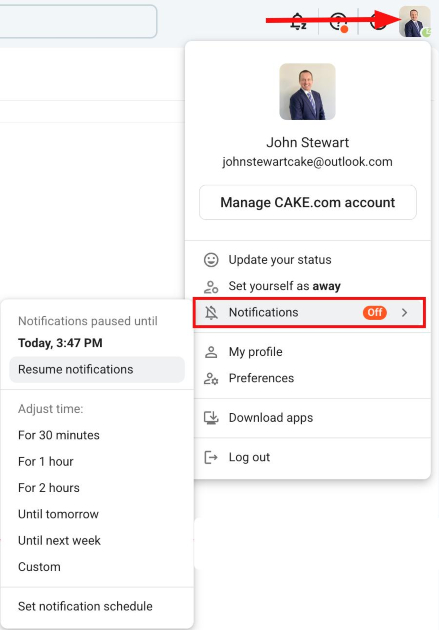
The team communication tool Pumble offers the option to pause notifications. While you’re in a meeting or in a deep work zone, you can continue your work regardless of any messages or video calls that come your way. The sender will still be able to convey the message, but it won’t disrupt your focus until the pausing time expires.
Similarly, Pumble offers the option to schedule messages. If you suddenly have an idea in the middle of the night, you can write it, but schedule it to arrive at 9 a.m.

Additionally, if you want to adjust the expectations of others on when they should expect an answer for you, you can set your Pumble status to In deep work, Focus time, or whatever works best for you.
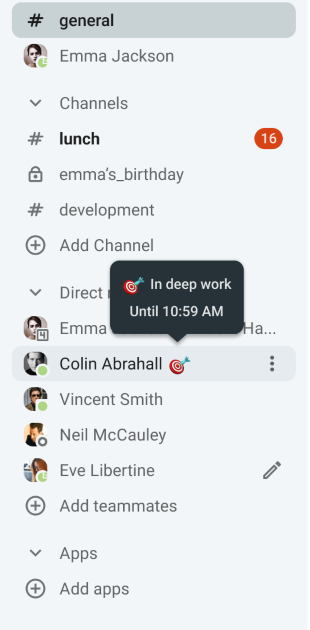
Deep work status in Pumble
Encourage the availability balance in your team
Having your team members available to you in a matter of seconds is great, but not at all times. Protecting your team members’ focus is far more important and beneficial for overall productivity.
Rakić explains the effect that supporting employees has when you enable them to work undisturbed:

“When an employee knows that they have the right to switch off and that they will not be looked down upon for doing so, they get the space to actually think, and not just reflexively react to urgent and often unimportant tasks.”
This opens the door to creative thinking, unparalleled focus, and superb productivity that goes far beyond just clocking in and out of work.
Max efficiency with CAKE.com tools
Boost your team communication with Pumble, time tracking with Clockify, and task management with Plaky.