Published: February 25, 2026
By definition, collaboration is the act of working with someone to produce something.
The fact that collaboration can thrive even in remote teams, through digital tools, and in asynchronous communication, is nothing short of great.
However, there are barriers, concerns, and underlying issues that block teamwork, and staying aware of these obstacles should be your company’s #1 priority.
That’s why we bring you the latest workplace collaboration statistics from reputable sources. Let’s dive right in!
- 1 in 5 employees feel lonely.
- 56% of employees believe meetings are a waste of time.
- 17% of employees turn to AI due to fear of human judgment.
- 36% of companies that have adopted remote or hybrid work report a lack of informal interaction.
- 39% increase in productivity is seen in companies that strengthen team collaboration.
- 1 in 2 knowledge workers claim that different teams work on the same things due to a lack of communication.
- 26% of employees report that poor interdepartmental relationships have contributed to their decision to leave.
Team communication and collaboration at work
Superb communication is the core of successful collaboration. But how many companies actually enable it, and what are the consequences of poor communication? Here’s what the latest statistics say about this.
46% of employees have missed messages due to bad communication
According to the Project.co Communication Statistics 2026, a serious lack of seamless communication can lead to employees:
- Missing messages — 46%,
- Experiencing lost and missing files — 26%, and
- Wasting time due to communication issues — 53%.
Essentially, without proper communication, collaboration is simply not possible.
43% of businesses rate themselves as average when it comes to communication
Only 3% of companies admit their communication is poor, whereas 46% believe their communication is either above average or excellent, according to the same Project.co statistics.
Finally, a whopping 43% of businesses rate their communication as average.
54% of employees report inefficient processes are a collaboration barrier
According to the McLean & Company Workplace Collaboration survey 2025, 54% of employees believe inefficient processes are hindering collaboration. Another 49% point the finger at complex organizational structures as the main obstacle to successful collaboration.
As it stands, companies should detect and resolve collaboration barriers to prevent negative outcomes — like losing talent.
While inefficient collaboration isn’t the only factor responsible for employees leaving, 26% of them report that poor interdepartmental relationships have contributed to their decision to leave.
The impact of meetings on workplace collaboration
Year after year, research shows that not only meetings, but preparation before them, and tracking after them, take up an enormous amount of valuable, productive time. Check out the statistics behind these claims.
Employees spend 15 hours a week just preparing for meetings
Meetings take up a lot of time, but preparation is also demanding. Zoom and Deloitte’s 2025 research found that employees spend 25 hours a week on meetings, 15 of which are spent on preparing for them!
The same research found that 10 minutes are lost per meeting when dealing with garbled audio, failed screen shares, and/or hardware glitches.
Furthermore, 94% of employees admit to experiencing challenges with meetings. Whether it’s preparing, participating in, or tracking meeting progress, almost every company is prone to meeting friction.
56% of employees report that meetings are a waste of their time
The amount of time spent on meetings may not be the biggest issue here, though. Project.co Communication Statistics 2026 research found that 56% of employees feel that time is simply — wasted.
56% of employees report that the only way to get the information they need is through meetings
And yet, meetings might be essential for your staff and their ability to do their jobs properly.
According to the Atlassian The State of Teams 2025 report, finding the right information can be hard. So, for over half of employees (56%), the only way to find what they need is to schedule a meeting.
Otherwise, they spend 25% of their workweek searching for information. And, executives know this, as 74% admit a lack of communication interferes with speed and quality of work.
Remote work and workplace collaboration
The Measuring Work From Home 2025 research found that 25% of all workdays were carried out from home in 2025.
The opinions about the impact of remote work on collaboration are divided. But statistics speak for themselves, so let’s dive deeper into research.
55% of surveyees claim office workers were seen as more trustworthy than remote colleagues
According to the Owl Labs 2024 State of Hybrid Work report, over half of surveyees (55%) noticed that office workers were seen as harder working and more trustworthy than their remote colleagues. But, if it’s any consolation, this number was much lower than in 2023, when 63% of employees thought this.
The Owl Labs State of Hybrid Work Report 2025 also found that the top reason 79% of employees believe their employers are enforcing return-to-office mandates is to improve productivity and collaboration. Whether it will actually help to go back to the office remains to be seen.
1 in 5 employees feel lonely
The State of the Global Workplace 2024 report found that 1 in 5 employees feel lonely. More specifically, 25% of fully remote, 16% of on-site, and 21% of hybrid workers feel lonely at work.
On-site employees feel the least lonely out of all groups of employees. The question is, can collaboration ever be efficient enough to prevent loneliness in employees?
Co-locating 50% of the time leads to employees reporting better teamwork 10x more often
According to McKinsey & Company’s insights for an SHRM article, coworkers feel like they work better together 10x more often if they co-locate (work from the same location) 50% of the workweek.
Even mentorship quality rose by 25% in teams that spent some time together. Another thing that was noticed is an increase in individual, client, and team outcomes when the in-person time was at least 20%.
However, the in-person collaboration charm only worked if the teams spent around 50% of their time together. Anything above 50% resulted in a decline in work-life balance satisfaction.
36% of employees believe collaboration suffers due to remote work
As stated in FlexJobs’ research, employees have strong opinions on the impact of remote work on collaboration:
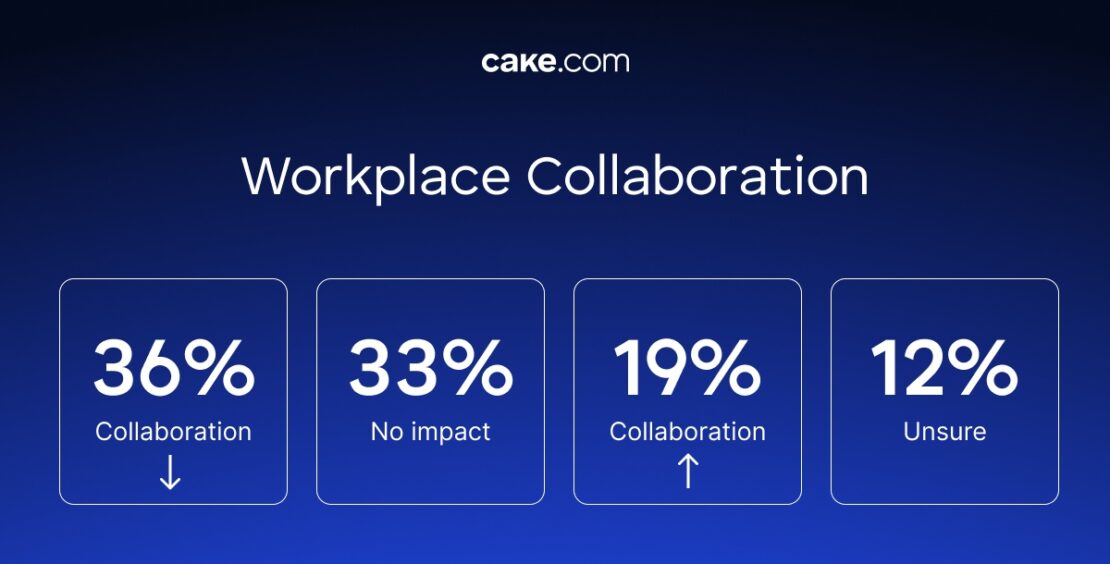
- 36% believe collaboration suffers when working remotely.
- 33% think remote work has no impact on collaboration.
- 19% argue that collaboration improves with remote work.
- 12% of employees are unsure about remote work’s impact on collaboration overall.
36% of WFH companies lack informal interaction
McLean & Company research found that 36% of companies that adopted remote or hybrid work claim to lack informal interaction. The informal communication research shows that informal communication in the workplace, such as the famous water cooler talks, helps employees integrate into the team and become more efficient.
However, only 13% of WFH companies found that employees were less willing to collaborate. This indicates that informal communication is important, yet not crucial in collaboration.
72% of leaders find that technology will positively impact collaboration in 2030
The key to enhancing collaboration in remote/hybrid teams may very well lie in adopting technology. 72% of leaders anticipate that technology will have a positive impact on collaboration in their organization in 2030, according to the same McLean & Company research.
Digital tools and workplace collaboration
As found by Fortune Business Insights, the team collaboration software market size is expected to grow from $31.62 billion in 2026 to $68.20 billion by 2034 at a compound annual growth rate (CAGR) of 10.1%.
As always, there are incredible benefits but also room for concern when using digital collaboration tools at work. Let’s see what the latest research says.
100% of employees know what their team members are working on when using a project management tool
A respectable 69% of employees say they are familiar with what others in their team are working on. However, if you add a project management tool into the mix, this figure skyrockets to 100%, according to Project.co’s research.
For comparison, without the use of such tools, and according to the above-mentioned Atlassian The State of Teams 2025 report, 1 in 2 knowledge workers claim that different teams work on the same things due to a lack of communication.
Manage projects like a pro
Assign tasks, set deadlines, track progress, and keep collaboration focused with comments and file sharing — all in Plaky.
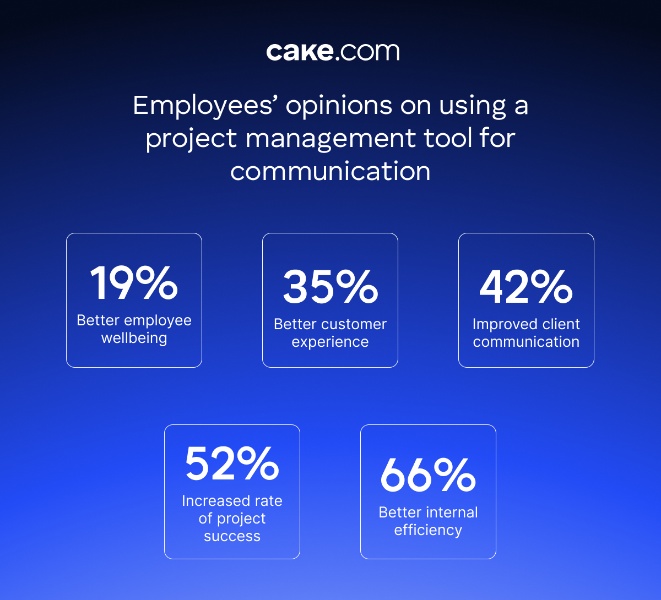
66% of employees find that project management tools lead to increased internal efficiency
76% of employees who use a project management tool to communicate with their team say it improves their internal communication, as stated in the Project.co’s above-mentioned research.
Here are some more stats about using a project management tool for communication:
- 19% associate it with better employee wellbeing.
- 35% claim it leads to a better customer experience.
- 42% say it leads to improved client communication.
- 52% think it delivers an increased rate of project success.
- 66% of employees argue it leads to better internal efficiency.
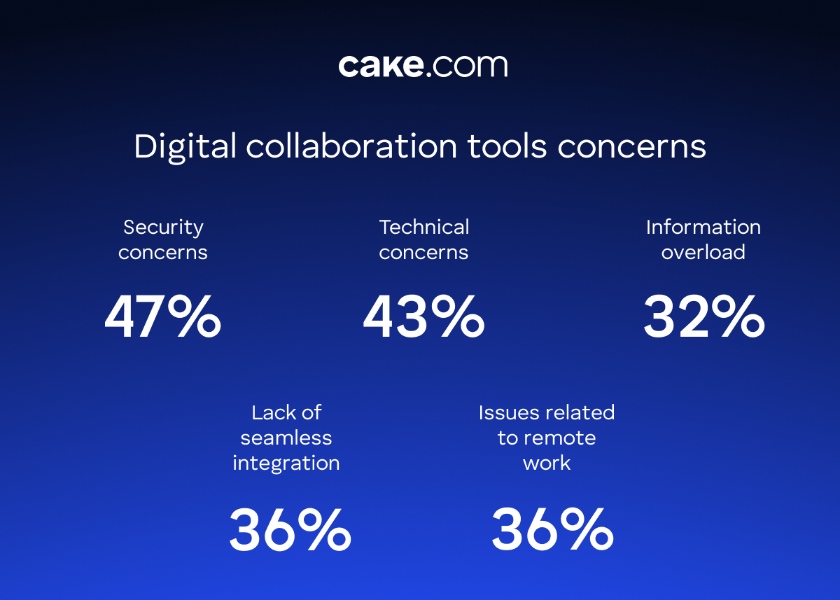
47% of employees have safety concerns about digital collaboration tools
That said, the McLean & Company Workplace Collaboration survey found that employees report the following concerns with using digital collaboration tools:
- Security concerns — 47%,
- Technical concerns — 43%,
- Information overload — 32%,
- Lack of seamless integration — 36%, and
- Issues related to remote work — 36%.
What’s more, the same research finds that if there is no formal structure around using these tools, it can lead to:
- Miscommunication,
- Increased digital noise,
- Overreliance on digital tools, etc.
Workplace collaboration benefits
Research shows that collaboration increases retention rates and makes for a solid reason to come to the office. Let’s dive deeper into the statistics on workplace collaboration benefits.
Collaboration is one of the top 3 reasons people come to the office
According to the Gensler Global Workplace survey 2025, 80% of surveyed employees claim to have made meaningful connections at work with colleagues of different ages, and 78% with colleagues of different roles.
The same research also shows that one of the top three reasons for coming to the office is collaboration, right next to meeting and socializing with colleagues.
Collaboration increases retention rates
As stated in SHRM’s State of the Workplace Report, teamwork and collaboration are the key aspects in increasing retention rates. Data from Gallup further supports this claim, as it has been found that when employees have at least one meaningful collaborative relationship at work, they are:
- 29% more likely to remain with their employer for the next year, and
- 43% more likely to stay with the company for their entire career.
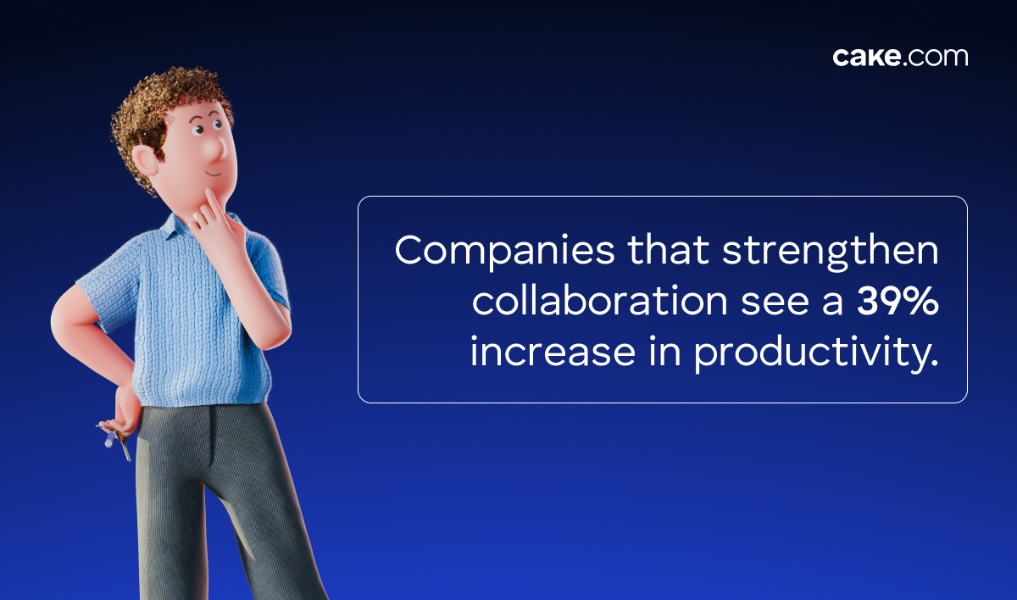
Companies that strengthen team collaboration see a 39% productivity increase
Collaboration is also directly linked to higher productivity levels. The Institute for Corporate Productivity’s 2024 study found a 39% increase in productivity in companies that strengthen team collaboration.
Employees are 5.4x more engaged when working in a collaborative work environment
The same McLean & Company Workplace Collaboration Survey 2025 found that employees who feel their organization nurtures a collaborative work environment are 5.4x more likely to be engaged.
The same research found that those who report working in highly collaborative teams have a higher workforce productivity than those who don’t.
Teams under 10 employees have the highest engagement rate. Or do they?
According to Gallup, teams with fewer than 10 employees have both the lowest and highest engagement levels. So, size is not the only indicator of successful collaboration and efficacy.
Both of these outcomes are, in fact, related to the manager. Managers can enable team members to form deeper bonds through collaboration, which leads to higher productivity.
Similarly, the Dream Team 2023 study found that collaboration in teams can thrive regardless of the team’s size as long as there’s a clear purpose, established roles, and proper communication involved.
So, don’t focus on the size of your team. Instead, work hard on providing your team with purpose and clarity.
The always-on culture is expanding
The 2025 Work Trend Index Annual Report by Microsoft shows that cross-time zone collaboration is thriving. Namely, there’s an increase of 16% in meetings after 8 pm due to both global and flexible teams.
Additionally, employees receive 117 emails daily, which translates to them being interrupted every 2 minutes. Interruptions make deep work feel impossible. The same research found that 60% of meetings are ad hoc instead of scheduled.
While this is great for collaboration, the question is — how will it reflect on workplace burnout?
Already, 40% of employees report having suffered from burnout, stress, and fatigue due to communication issues, according to the Project.co Communication Statistics 2026 research.
1 in 3 employees report low collaboration levels
As reported by the McLean & Company Workplace Collaboration Survey 2025, companies often lack the right approach to collaboration.
1 in 3 employees claim that collaboration levels aren’t high in their company. At the same time, 1 in 15 admits their companies are collaborating too much.
In the end, finding the right approach to collaboration means knowing your team and how it functions best.
86% of employees believe that enabling collaboration is a shared accountability
McLean & Company Workplace Collaboration Survey 2025 found that 86% of employees believe that HR, senior leaders, people leaders/managers, and individual contributors all share accountability for enabling collaboration.
This implies that the whole company and all its structures must actively participate in enabling collaboration to be able to enjoy its many benefits.
AI and workplace collaboration
In 2024, 75% of knowledge workers were already using AI, according to the above-mentioned Microsoft Work Trend Index Annual Report.
As stated in the LinkedIn Skills On the Rise 2025 report, AI was seen as the most in-demand skill in 2025. But will it hinder or uplift team collaboration? Let’s see what the latest statistics say.
73% of leaders say AI has made employees more productive when working together
As stated in the Express Employment Professionals – Harrison Poll Survey 2025, 73% of decision-makers claim that AI has helped employees become more productive when working together.
Furthermore, 72% have noticed that employees now collaborate more easily in real time.
However, although collaboration may appear easier with AI, there are growing concerns about how it will affect long-term collaboration. The same Harrison Poll research found that 55% of managers are concerned that AI could eventually replace the need for collaboration altogether.
17% of employees turn to AI due to fear of human judgment
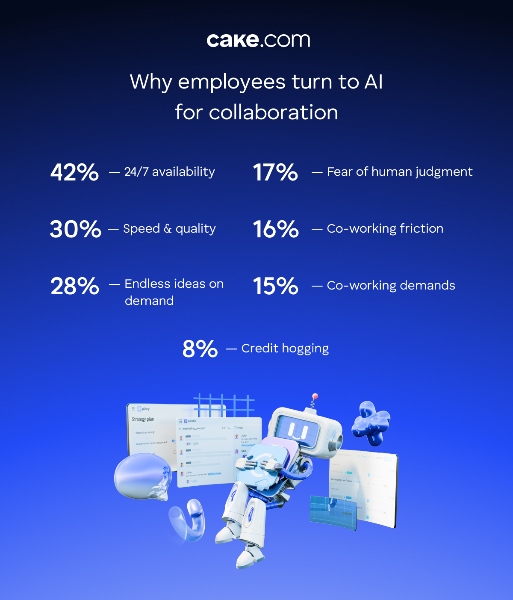
The 2025 Microsoft Work Trend Index Annual Report shows that sometimes, instead of collaborating with colleagues, employees turn to AI. There are 3 key reasons why this happens:
- 42% rely on AI because it’s available 24/7.
- 30% favor it because of its speed and quality.
- 28% prefer using it because it offers an endless stream of ideas on demand.
However, some of the answers also showed the fragility of human collaboration:
- 17% of employees turn to AI due to fear of human judgment.
- 16% of them use AI due to workplace friction.
- 15% rely on AI because they find working with their colleagues too demanding.
- 8% go for AI due to credit hogging, as they want to take full credit for the completed work.
While these digits are somewhat lower, they show the employees’ desire to avoid collaboration at times due to complex human nature.
46% of leaders find that human-AI collaboration will improve the decision-making process
According to McKinsey’s The State of Organizations 2026, leaders think human-AI collaboration will bring many benefits:
- 48% of them claim it will improve information access.
- 47% expect it to reduce administrative work.
- 46% believe that collaboration with AI will improve the effectiveness of decision making.
On the other hand, slightly more than half of leaders (53%) expect AI to remain a supporting tool during the next 2 years. What’s more, a quarter of them expect AI to take on agentic roles and become an autonomous teammate to human employees in the same period.
Improve your workplace collaboration to achieve maximum efficiency
The latest statistics clearly show that collaboration is your super tool to increase productivity, improve communication, and reduce your turnover rate.
Practice shows that holding too many meetings is counterproductive, and that project management tools are outstanding when used for communication as well.
So, our advice is to foster collaboration in your workplace for the benefit of both your employees and all of your tasks as well. If the data is correct — you won’t regret it.
Streamline operations with CAKE.com
Discover the true power of integration. Use Clockify, Pumble, and Plaky together to simplify your workflows and increase efficiency.