Published: December 5, 2025
So you want to become more productive and think habit stacking is the way to go?
You’re onto something there, but you should know that the results won’t be immediate.
Habit formation strategies like this are optimized for creating lasting habits — not for increasing productivity.
That said, while the short-term ROI that habit stacking gives is often unnoticeable, it does pay dividends in the long run.
Let’s talk details!
- Habit stacking is an effective technique for building new habits.
- New activities should be manageable; you should perform them every single day if possible.
- Habit stacking implies doing one thing after another — performing both at the same time is habit pairing.
- To successfully build a habit, be mindful of which activity you stack it on top of.
What is habit stacking and how does it work?
Habit stacking works by sequencing new behavior on top of already existing habits.
Say you’re the resident email ignorer and you want to change this. If you just make it a goal to check all new emails every day, this likely isn’t going to work. Not because that’s too much work — it’s probably not — but because the instructions are unclear.
When would you do this? Would you check all emails at once or several at a time? And how many would several be?
Waiting to feel like checking your emails isn’t a viable strategy, and setting an alarm often results in problematic timing. Unless the alarm rings exactly while you’re twiddling your thumbs, chances are you’ll have something else going on and just ignore it.
But, with habit stacking, you could say, “After I start tracking time, I will go through the 10 most recent emails.”
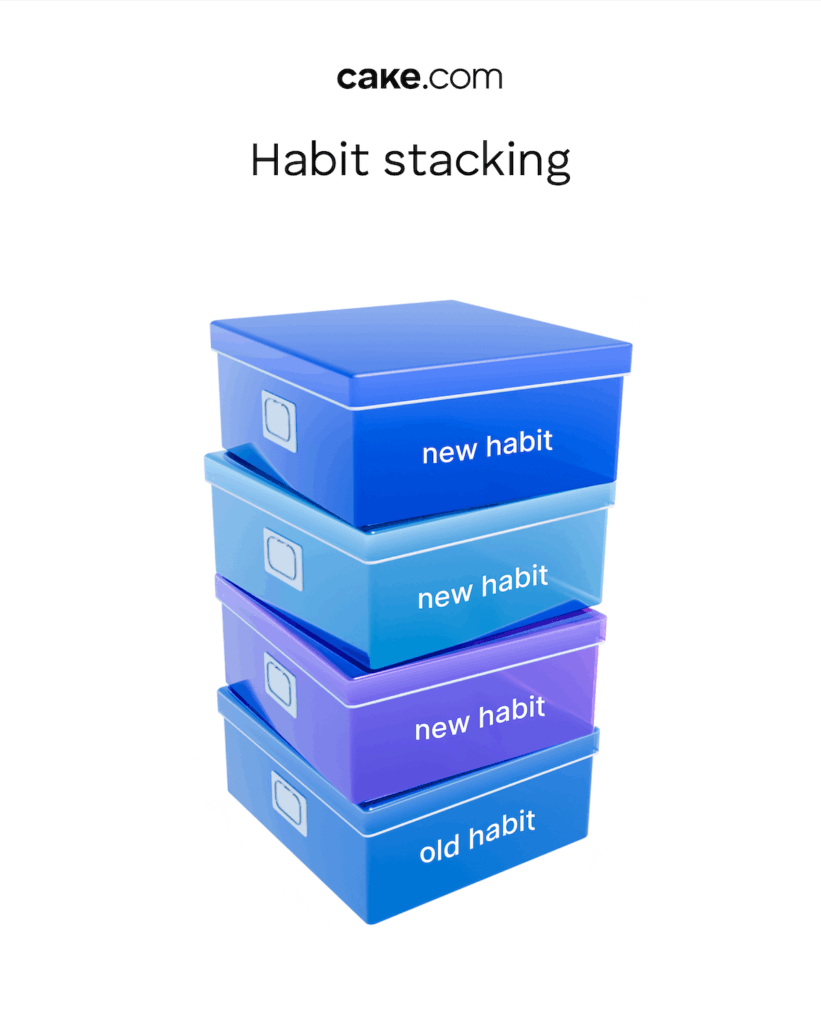
In other words, you use a habit that you already have — even if it’s just starting your time tracker — as a trigger to start the new activity. The instructions are clear, the trigger is precise, and the timing isn’t problematic.
This small detail makes consistency in habit building much higher.
If you’re curious about why this is the case, check out the section titled The science of habit building near the end of the article.
Habit stacking examples
To help kickstart your creative juices, here’s a bunch of habit stacking examples, with a heavy emphasis on productivity at work.
They all follow the set formula:
When/After [trigger habit] I will [new behavior]
- After a meeting ends, I will write down 1-3 priority action items discussed and assign deadlines.
- When I start a deep work session, I will mute my phone and all notifications.
- When I finish a Pomodoro block, I will stand up and stretch for 1 minute.
- When I start work, I will first review my daily task list and prioritize it.
- After I set my code to compile, I will read a news article related to my industry.
- When I’m done writing an important email, I will read it aloud to check for grammar and tone.
- When I stand up to leave my desk, I will take one piece of clutter with me to throw in the trash.
- When I receive an invitation to a meeting, I will check if I’ll have at least an hour of time for deep work left over before accepting it.
- When a colleague asks me for help, I will spend 5 minutes thinking about the best way to instruct them, instead of giving them a solution.
- After I’m done with a toilet break, I will refill my water glass and put it on my desk.
- After I complete my first task for the day at work, I will take a coffee break. (Not before!)
- After I open a new browser tab, I will check my posture and adjust my back.
- When I pick up my phone, I will explicitly state what I intend to do (to stop myself from being distracted by the first thing that pops up on screen).
- After I complete the last task at work for the day, I will close all irrelevant tabs before turning the device off.
How to stack habits effectively
There are 4 steps to effective habit stacking:
- Identifying existing habits,
- Choosing new activities,
- Stacking them, and
- Reinforcing the stack.
Let’s go through them one by one.
Step 1: Identify existing habits
With habit stacking, you want the new activity to piggyback off of the consistency of the habit that precedes it. So step 1 is identifying the habits you can work with.
James Clear, the author of Atomic Habits, who popularized habit stacking, suggests making a table with 2 columns to identify potential triggers:
- One for habits that you already have and
- The other for things that happen (to you) without fault.
| Things I do everyday | Things that happen (to me) everyday |
|---|---|
| Get out of bed | I get a text message |
| Eat breakfast/lunch/dinner | The video I’m watching ends |
| Change clothes | The sun rises/sets |
| Check emails | My phone rings |
| Start/stop working | I get the impulse to buy something |
| Open business chat app | A colleague asks for help with a task |
| Put shoes on | I receive a meeting invitation |
| Shower | A meeting ends |
Your list will be more personalized, of course. Maybe you turn on your PlayStation everyday or you walk your dog.
Manage projects like a pro
Assign tasks, set deadlines, track progress, and keep collaboration focused with comments and file sharing — all in Plaky.
Step 2: Choose new activities
Next up, choose what it is you want to turn into a habit.
Then make it as unambitious and simple as you can!
I’ll explain why through an example.
Say you want to make a habit out of doing 2 hours of deep work. The new activity shouldn’t be, “I’ll do 2 hours of deep work” — you probably won’t be able to stick with it regularly, which will demoralize you and make you stop trying.
But, if you say, “I’ll do 15 minutes of deep work”, that’s manageable. You could even just commit to the prep work for the habit: “I’ll turn off all notifications and put my phone in a drawer.”
Step 3: Stack new activities on top of existing habits
So, once you’ve scaled down the desired activity enough to do it consistently, you just slap it on top of a habit trigger and that’s it, right?
Nope!
If you want the new habit to stick, you have to be mindful of what trigger habits you use and when they occur.
Going through 10 emails after you open your work laptop isn’t likely to cause any scheduling issues. However, committing to deep work (even if it’s just for half an hour) will be a problem if your work day often starts with meetings or urgent tasks that require you to be available.
This doesn’t mean you have to give up on the idea of deep work. Just stack it on top of a habit that won’t result in problematic timing.
For example, you could say, “After I finish the daily Scrum, I’ll do half an hour of deep work.” This way, you could let your team know what you’ll be working on and ask them not to bother you for a bit unless it’s an emergency.
Step 4: Reinforce the stacks
Once you’ve made the stack, you just need to reinforce it.
I say just, but this is the most difficult part — sticking with the stack long enough to turn it into a habit.
For reference, it takes 66 days on average to form a habit, though this can range anywhere between 18 and 254 days. So, consistency is key!
Doing something for 5 minutes every day is way more impactful for habit formation than doing that same thing for 35 minutes once a week.
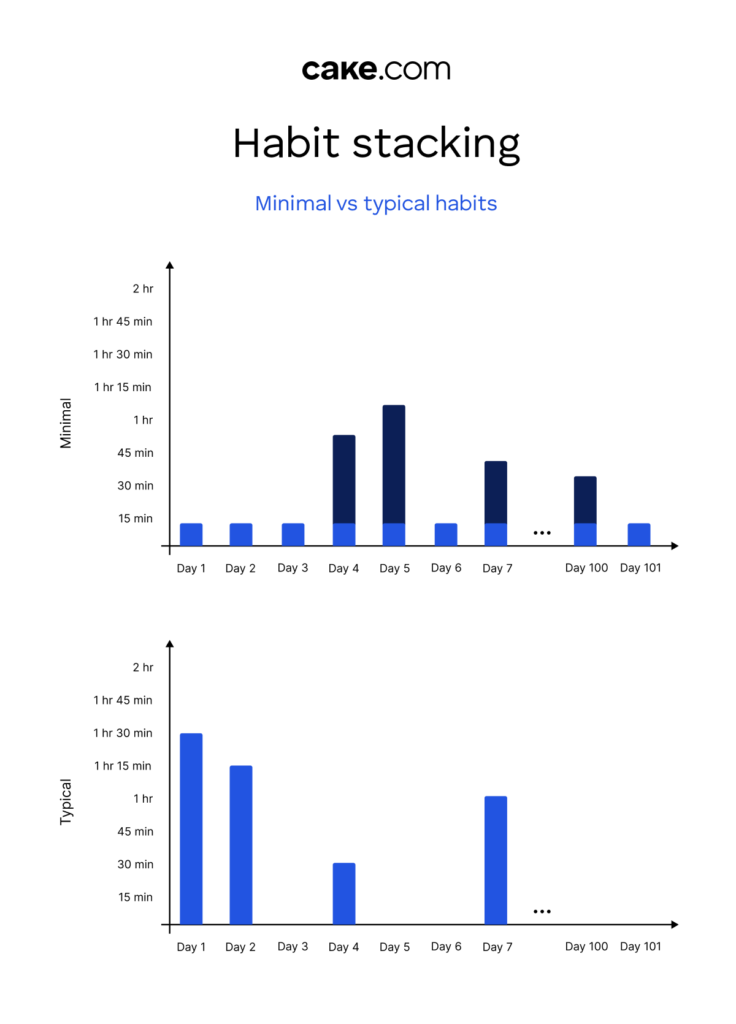
So scale down the new activity and do it every day (or every work day, if it’s work-related). If you find it difficult to maintain consistency, either scale it down further or change the trigger habit.
And, once you’ve successfully turned the new activity into a habit, you can continue stacking new activities on top of it.
Further reading:
Habit stacking isn’t the only way to increase productivity. In this article, Dr. Mithu Storoni, author of “Hyperefficient”, shares other tips and tricks you can use:
The science of habit building
So why is it that you have to jump through this many hoops just to get a habit to stick?
It all has to do with the way our brains change as we age.
When you’re born, your brain has a ton of neurons but very few synapses — connections between neurons that result in behavior. The more you perform an activity, the stronger the synapse associated with it becomes.
This is why, when you’re trying to pick up a skill, like typing without looking at the keyboard or driving a car, it starts off difficult and gradually becomes easier and easier, until it becomes effortless. We call this muscle memory, but it’s not the muscles that are responsible — it’s the synapses in the brain.
You have more neurons in early childhood than you do during the rest of your life because your brain is essentially a blank canvas at that point. It needs to form all synapses from scratch.
But the brain also likes efficiency, so it doesn’t leave unused infrastructure just lying around. That’s why the synapses that aren’t used basically get dismantled while the ones that are used get reinforced through a process called synaptic pruning or — as I like to call it — use it or lose it.
Why is this info dump important?
Well, starting a new habit basically requires your brain to form a new stable synapse. And this gets increasingly more difficult with age. It’s not that it can’t do it, but it’s lazy — it has all the enthusiasm of a DMV clerk (and works with just as much spring in its step).
Habit stacking is an effective shortcut because it relies on already existing brain infrastructure. You’re not building a completely new synapse from scratch. Instead, you’re hitching a ride on one that’s already established to kickstart the process of building a new habit.
In neuroscience, this is known as Hebb’s law, which is often summarized by the phrase neurons that fire together, wire together. It still takes time and effort to form a habit this way, only much less of it.
Further reading:
If you’re curious to learn more about the inner workings of the brain, specifically how disorganization and clutter affect it, check out this article:
Habit stacking vs habit pairing
Now, you might be thinking, “What if I changed the formula a bit so that instead of after it says during or while”, i.e.,:
I will brainstorm ideas for the next initiative while walking on the treadmill.
Strictly speaking, this isn’t habit stacking.
Habit stacking involves sequencing activities — not doing them simultaneously. First you do activity A, then you immediately follow it up with activity B.
What you get when you pair activities instead of sequencing them is called habit pairing.
Does this distinction matter?
No, not unless you’re trying to argue semantics.
If you just want to be more productive, use whatever works for you — and habit pairing does work!
You can pair mundane activities like washing the dishes or driving with listening to audio books or educational podcasts to learn while doing chores.
The key here is to pair complementary activities — usually some manual labor, like doing chores, with an activity that is mentally stimulating.
At work, we tend to already be mentally engaged by our regular tasks, but that doesn’t mean that habit pairing has to go out the window. Some people use under-desk treadmills to walk while attending meetings. In this case, they’re pairing physical activity with work. And walking actually boosts creativity and concentration!
So if you have the opportunity to make yourself more productive by pairing two things that won’t negatively impact each other, do it! Who cares what the technical term for it is.
Choose a pricing plan that fits your needs
Pick a set of superb features to take your business to the next level. The CAKE.com Bundle gets you Clockify, Plaky, and Pumble at a 53% discount!


Habit stacking is not a productivity technique per se
Habit stacking is not a productivity technique. It’s a habit building technique.
Of course, you can use it to strategically build habits that will make you more productive, as you’ve seen in the examples I’ve provided.
But habits take time — especially if they’re big things that are supposed to have a large impact on your work.
Doing 15 minutes of deep work won’t transform how you work overnight, which brings me back to the point I made in the intro:
Habit stacking offers low short-term ROI. It’s just not optimized for that.
The most important thing for habit building is to be consistent, so don’t be afraid to start small — your efforts will snowball into something bigger if you give them time.Looking for tools to become more efficient at work? Increase your productivity quickly with Clockify, Pumble, and Plaky — all part of the CAKE.com Bundle.
How we reviewed this post: Our writers & editors monitor the posts and update them when new information becomes available, to keep them fresh and relevant.