Published: February 2, 2026
Whatever you say, your words end up getting twisted.
Whatever you do, you’re somehow labeled as the “sensitive” one.
Although the situation feels like something straight out of Inception, you’re actually in your 9-5 job, thinking about what went wrong — and feeling like a total loser.
Turns out, you might be experiencing gaslighting at work.
- Gaining control and avoiding productivity are 2 main motives behind gaslighting.
- The first step in dealing with a gaslighter is to start documenting every conversation and agreement between you and them.
- Gaslighting in itself is not illegal — but it can fall under the Title VII of the Civil Rights Act of 1964 if there is discrimination involved.
What is gaslighting?
Gaslighting is a type of manipulative abuse where another person wants to exert power over someone by making them feel confused, isolated, and question their own perception of reality.
Funnily enough, the term doesn’t stem from psychological literature. Rather, it comes from a 1938 play, Gaslighter, later made into a movie starring Ingrid Bergman as Paola — a woman led to believe that her husband was purposely dimming the gaslights every night.
The movie won several Oscars, and the term gaslighting was never forgotten. In fact, it was the Merriam-Webster word of the year in 2022.
However, the popularity of the term doesn’t bring any comfort to gaslighting victims, as it occurs more and more frequently at work as well. A toxic manager, a scheming colleague, or a dissatisfied client can leave you feeling completely disoriented and unable to trust yourself.
Demystifying gaslighting behaviors
According to a gaslighting study from 2023, there are 2 main motives behind gaslighting:
- Gaining control and
- Avoiding accountability.
The gaslighter wants to exert control over their colleague. Once they dominate the person’s mind and actions, the gaslighter can continue with whatever they’re doing. The stronger the grip, the more dependent the gaslit coworker becomes.
When the gaslighter makes the victim doubt their own decisions and feelings, they can continue with their inappropriate behavior. And if we translate this to office behavior, it may be your colleague covering up for their own lack of ideas, incompetence, or badly performed tasks.
Gaslighters have a few common traits that you can recognize them by. As Psychology Today mentions, most gaslighters:
- Lie and exaggerate frequently,
- Show aggressive behavior when confronted with the truth, and
- Project a false image of themselves (they usually portray themselves as successful and charming).
Knowing what these traits are is vital when you need to handle gaslighting in the workplace.
Licensed Social Worker and Clinical Director Candace Kotkin-De Carvalho points out that taking advantage of coworkers is, in fact, a gaslighter’s end goal:

“By creating confusion, doubt, and uncertainty, gaslighters can manipulate their victims into behaving in ways that are advantageous to them. The tactic is designed to make the victim feel as though they are unable or unworthy of succeeding in their workplace, and it can be incredibly damaging for everyone involved.”
10 examples of gaslighting at work
Gaslighting may take many forms, and learning how to recognize them is the best way to handle it. Let’s see the 10 most common examples of gaslighting at work.
#1 Lying about what happened
For instance, when you talk to your boss and agree on a specific project question, only to have your boss deny that it actually happened. This can also happen if you are working on a task with a coworker, and they deny discussing certain points with you in the past.
#2 Shifting blame over to you
When things go wrong, gaslighters will try to convince you that you are to blame for the negative outcome. You can recognize this by the fact that you weren’t responsible for, or couldn’t have controlled, the outcome in the first place.
And yes, it could be something quite simple, such as sending out invitations (check out the visual below). But don’t be fooled — even something as trivial as that has probably been strategically picked by the gaslighter to destroy your confidence.
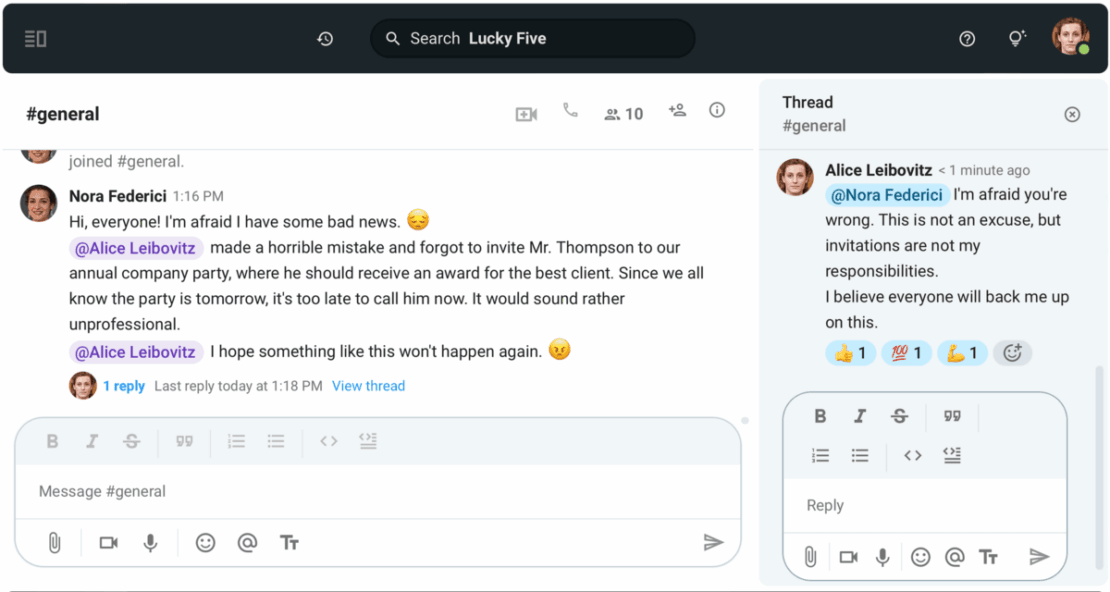
Yes, gaslighting at work can even happen in team chat apps like Pumble
#3 Saying one thing and doing another
If your boss claims being late is unacceptable, yet they themselves are constantly late, this may be an example of gaslighting. Whenever there is a gap between what the other person is saying and doing, it’s a red flag for possible gaslighting practice.
#4 Downplaying your success
POV: You had finished an important project, and your boss spoke highly of it to you in private. However, during the team meeting, that same boss highlighted some of your errors and undermined your success.
#5 Keeping information from you
If your boss or your colleagues intentionally withhold information from you, with the purpose of them appearing superior to you, then you’re probably being gaslighted.
This way, during a team meeting, you aren’t able to draw conclusions you normally would, simply because you don’t have enough information. Ergo, you seem like you don’t know how to do your job!
#6 Excluding you from meetings
And not only meetings. When your coworkers or boss “unintentionally” forget to invite you to a meeting, team building event, or conference, that’s a red flag. After you call them out on it, they’re most likely to say they just forgot to invite you, and that there’s no reason for you to get upset.
#7 Isolating you from your colleagues
When someone at work starts to spread rumours about you, what they really want is to separate you from the rest of the team. It also functions the other way around, when they tell you in confidence what the other colleagues have been allegedly saying about you. Creating a hostile work environment is a fertile ground for successful gaslighting.
#8 Refusing to listen to any of your concerns
When you are not okay with inappropriate jokes made about you, you are being labelled as “too sensitive”. Or, if you voice your concerns about how you’re being treated in your workplace, your superior casually disregards them.
#9 Implementing vague policies
Clear and precise policies are the backbone of a healthy atmosphere at work. When your boss implements a policy that is not specific, they can refuse any of your requests even though you did everything right.
For example, if a PTO policy states that you should request your days off in advance, and you do that 2 weeks prior to your vacation — your boss can easily say that you should have done it even sooner. After all, “in advance” can mean so many different things to so many people!
#10 Undermining your confidence
Finally, if you are constantly given smaller, seemingly unimportant projects and tasks to work on, or your boss keeps making statements about your ability to perform complex tasks — beware. This is a sign you’re being gaslit at work, aimed directly at your confidence and well-being.
Common gaslighting phrases & how to respond to them
All of the above-mentioned examples can happen on a daily basis, and it’s vital to recognize them as soon as possible.
Here are some common gaslighting phrases to help you catch the gaslighting behavior sooner. We’ve also included useful phrases to shut down the gaslighter ASAP.
| What you hear | What you should reply |
|---|---|
| “I didn’t mean anything by it. Stop making such a big deal out of it. You’re being dramatic!” | “I am allowed to explore these topics and conversations with you. Do not tell me I am being dramatic.” |
| “You’re too sensitive.” | “My feelings and reality are valid. I don’t appreciate you telling me that I am being too sensitive.” |
| “You’re imagining things. That’s not how it happened.” | “I know what I saw. Don’t try to convince me of something I know is not true.” |
| “Your memory seems to be slipping.” | “My memory is perfectly fine, thank you. I know you’re trying to make me question my sanity, but it’s not going to work.” |
| “I never said that! You’re misinterpreting everything.” | “I know what you said. Don’t try to convince me of something I know is not true.” |
| “You’re reading too much into this. It’s not that big of a deal. You’re overreacting.” | “I will not continue this conversation if you continue to minimize what I am feeling.” |
| “You need to calm down. There’s no reason to get so upset about this.” | “Don’t tell me how to feel. This is how I feel.” |
| “I was only joking.” | “I know what I saw. Stop pretending you were only joking.” |
Note: These phrases or examples alone don’t always mean you’re dealing with a gaslighter. However, if this type of behavior repeats, and you start to question your sanity, it’s time to act.
How to deal with gaslighting
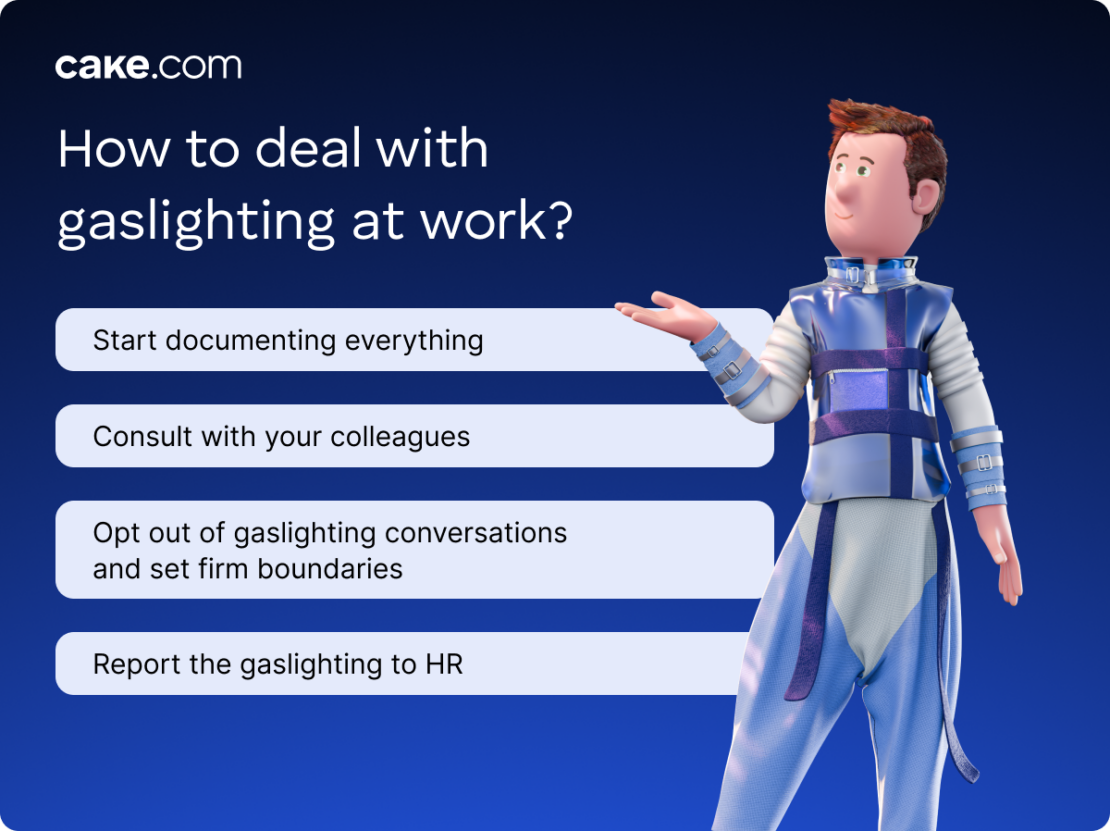
Start documenting everything
When you start questioning yourself, and when you constantly have a feeling that something is wrong — ideally even before gaslighting gets this far — start documenting everything that is agreed between you and the gaslighter.
This includes every promise, notification, or message that comes from them. State the time and place, and soon you’ll begin to see what doesn’t add up.
Licensed Psychoanalyst Robin Stern advises notifying your gaslighter that you’ll be keeping track of everything:

“Make sure you record every conversation by saying to your gaslighter upfront: ‘After the meeting, I’m gonna send you an email just confirming what we talked about.’”
Effortless communication begins with Pumble
Enjoy unlimited chat history, threads, public and private channels, high-quality video calls, and more.

Consult with your colleagues
Chances are, your colleagues have also noticed that you’re being gaslighted. Approach at least one of your colleagues, and it will be enough to confirm your suspicions.
Stern advises that you ask them in the most straightforward way possible:
“Check it out with your friends at work: ‘I see it this way. I’m a little unsure. I’m trying to sort things out for myself. What do you think?’”
This segment is important as the gaslighter will try to isolate you from your colleagues at some point. So finding someone you can trust is invaluable.
Opt out of gaslighting conversations and set firm boundaries
If the conversation is making you uncomfortable and is emotionally exhausting — opt out of it. Stern gives us an example of what you should say when things get tough:
“If you have a gaslighter who is going to be contemptuous and dripping with sarcasm or criticize you or start screaming at you because you’re confronting them about something you don’t like, it’s wiser not to go further. In that case, setting limits is the way to go. You can use clear statements, such as: ‘I’m not going to continue the conversation until you decide to talk without being sarcastic.’”
According to Forbes, setting firm boundaries to gaslighters means defining what you will not tolerate and enforcing consequences, such as removing yourself from the conversation until the gaslighter adjusts the tone and the message.
Report the gaslighting to HR
If going to work feels unbearable, and you no longer feel safe, productive, or emotionally stable, report what is happening to your HR department. Because sometimes, if you want to outsmart the gaslighter, you need to take it to the next level.
Bring your tracked records, and mention every aspect in which you believe you’re being gaslighted. The HR department will advise you on further steps and take appropriate actions toward the person gaslighting you.
Remember, you don’t have to do it alone.
Is gaslighting legal?
Gaslighting in itself is not illegal. However, if it results in discrimination based on gender, age, sexual orientation, pregnancy, disability, race, religion, etc., it then falls under Title VII of the Civil Rights Act of 1964. If a gaslit employee can prove that the gaslighting has led to discrimination, they can press charges.
Can you recover from gaslighting?
Therapist & Owner Kaila Hattis has no doubt that recovering from gaslighting is possible, as she emphasizes the importance of trusting yourself in the first place:

“Trusting your own memory over another person’s lies is the first step toward healing.”
Hattis goes on to explain that it is the consistency of external validation that plays a significant role in recovery as well:
“There are many ways to recover from these mental health issues, with some of the most effective being reality checking and receiving outside validation on an ongoing basis.”
Finally, Hattis concludes that seeking the help of an expert offers the highest percentage of recovery:
“Research indicates that individuals seeking out specialized coaching and therapy experience a 70% increase in professional confidence at 6 months post-treatment.”
So, there you have it. Trust your own memory, find support outside of work, seek the help of an expert — and don’t give up until your confidence comes back.
Elevate productivity with CAKE.com
Combine time tracking, team communication, and project management to boost your organization’s productivity — with the CAKE.com Suite.