Published: October 21, 2026

A common misconception is that artificial intelligence will disappear once the AI bubble bursts. This simply isn’t the case.
To understand why, we need to make the distinction between AI the technology and AI the asset class and look back on how previous revolutionary general-purpose technologies (GPTs) — like electricity, computers, and the Internet — have outlived the market bubbles they spawned.
- AI the technology is the product you use, while AI the asset class is the investment vehicle. Bubbles form in asset classes, not in technologies. When the AI bubble bursts, the technology will remain.
- The golden age of any general-purpose technology starts after the bubble bursts and production capital takes over. However, bubbles are the only way to build necessary infrastructure ahead of demand.
- Electricity took 40 years to start improving productivity because it was being retrofitted onto existing processes not designed for it — the same is happening with AI.
Technology vs. asset class
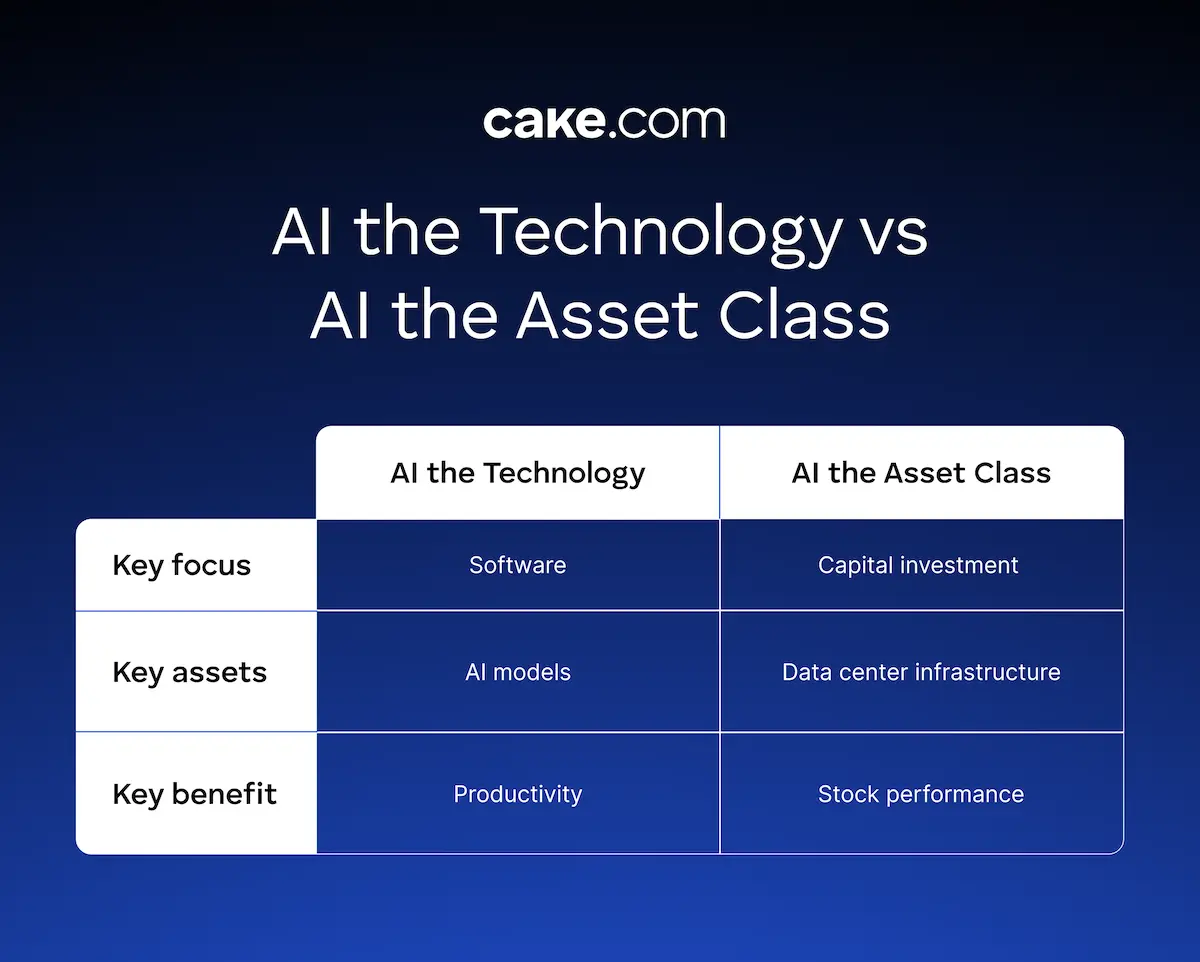
As a technology, AI is the product that people use. Putting aside the question of its profitability, it creates value by writing code, analyzing data, or automating tasks, among other functions. When talking about the technology, the question is what it can do.
As an asset class, AI is the investment vehicle. It creates value through return on investment, stock price appreciation, and market speculation. When talking about the asset class, the question is how much profit it can generate.
When you buy the asset class, you’re not necessarily investing into the technology itself. You’re not funding the next big frontier model training. In most cases, you’re investing into things that stand to profit from people using the technology. Kind of like how the person who buys land next to a highway stands to benefit from people using cars — they could open a restaurant to feed the drivers.
This distinction is important because bubbles happen in asset classes, not in technologies. According to Sequoia partner David Cahn, AI would need to generate almost $3 trillion in revenue to justify all the infrastructure spending. If it doesn’t manage to do so, the AI bubble will burst — the asset class will go kaput, but the technology will remain.
How bubbles form and what they leave behind
Bubbles tend to form around revolutionary technologies precisely because they’re revolutionary. Investors see that this is the future, and they want to get in on the action early to maximize the return on investment. The problem is, they tend to overestimate the short-term ROI.
When these same people realize that the short-term ROI they were hoping for isn’t real, and that they’re investing into a money sink, they hurry to sell and recoup what investment they can. This triggers a frantic selling frenzy and, with no one willing to buy, the asset class plummets in value, bursting the bubble.
This happened with the dot-com bubble around the start of the new century. Investors saw that the Internet was the future. The benefit of hindsight shows us that they were right. But they severely overestimated the short-term ROI. That bubble reached its peak in 2000 when the Nasdaq stock index hit its all-time high. It burst quickly after, and, by 2002, the crash had wiped out more than $5 trillion in market value.
The Internet, however, didn’t disappear. It remained and got integrated so deeply into society that everyday life without it now looks unimaginable.
The same thing will likely happen to AI. In fact, AI being in a bubble right now only serves to benefit the technology, since only bubbles can build the necessary infrastructure for revolutionary new general-purpose technologies to enter their golden age.
The Carlota Perez Framework — how bubbles build infrastructure
According to Carlota Perez, each technological revolution is divided into an installation phase and a deployment phase.
Within the installation phase, there’s a period of frenzy, when speculative investment overtakes actual production values. This inevitably comes to a turning point when the speculative bubble bursts, causing a financial crash.
What follows is the deployment phase — the so-called golden age of each technology — that’s driven by actual production capital. This is when the technology matures, gets regulated, gets widely adopted, creates new jobs, increases productivity, and brings about economic growth.
Perez argues that this speculative mania is a necessary evil, since conservative capital could never take the financial risk needed to build a nationwide or global infrastructure ahead of actual demand. It took the dot-com bubble to deploy fibre-optic cables around the world that made the golden age of the Internet we now live in possible.
Why AI feels lackluster at the moment — the productivity paradox across previous GPTs
MIT Institute Professor and Nobel laureate Daron Acemoglu calculates that, in the next 10 years, AI will increase the GDP by just 1%. OpenAI released a study saying that there’s no correlation between revenue per employee and tokens spent.
AI isn’t the first general-purpose technology that was released to much fanfare yet offered little to no productivity gains. Examining why this was the case with previous GPTs helps shed light on what you can expect from AI moving forward.
Electricity may be the best example of this. The first commercial electric power stations opened in the 1880s, but it wasn’t until the 1920s that we got the massive productivity boom from electrification. So, why the 40 year long gap?
Further reading
One of the reasons for AI’s mediocre performance is its prohibitive cost, which is only expected to rise. Read more about it here:
Well, for 40 long years, the new technology was just being retrofitted onto existing processes designed with the steam engine in mind!
Before electricity, factories had massive, centralized steam engines that powered machines through ceiling mounted drive shafts. Because of the limitations of these engines, factories had to be tall, multi-floored buildings — it was just more practical to transfer power vertically than horizontally.
The reason electricity didn’t result in any productivity gains for so long was because factories simply replaced their massive, centralized steam engines with massive, centralized electric motors. They retrofitted the technology, treating it as a 1-to-1 substitution.
The productivity gains came when engineers figured out they could fit a small, cheap electric motor on each individual machine. This allowed them to flatten factories and organize them with the flow of raw materials in mind, paving the way for the assembly line.
AI is going through the same retrofitting process. Nowadays, one of the main pushes for AI is in coding, but while AI has increased the volume of code written, this hasn’t translated to more products/features being shipped. This is because more time is spent on code review, since humans have to check all the AI code.
Further reading
If you’re worried about AI making your job redundant, check out this guide to learn how to make yourself AI-proof:
What this means for future of AI and your productivity
When the AI bubble bursts, the headlines will announce the death of artificial intelligence. But the technology won’t go away — it will just get democratized.
If history is any indicator, that’s when the real productivity gains will be made — when the speculators leave and a market driven by actual production capital can innovate new use cases for the technology.
The money that’s being poured into the speculative market may disappear, but the infrastructure built will remain. This may be the data centers — if they ever get built — or the countless GPUs Nvidia is producing that have nowhere to be plugged in.
It’s impossible to imagine what the future will look like. No one could have predicted remote work, cloud technology, or smart TVs during the dot-com era — the Internet back then was basically just webpages, accessible through directory-based searches on dial-up.
Until then, AI will continue to offer meaningful productivity gains in only a handful of use cases, much like how computers significantly boosted the productivity of accountants when they came out, while offering very little in the way of productivity to most other professions.
So don’t feel pressured to retrofit AI onto your existing processes if it doesn’t provide a clear benefit. Keep using the tools that actually maximize productivity and profitability.
Elevate productivity with CAKE.com
Combine time tracking, team communication, and project management to boost your organization’s productivity — with the CAKE.com Suite.